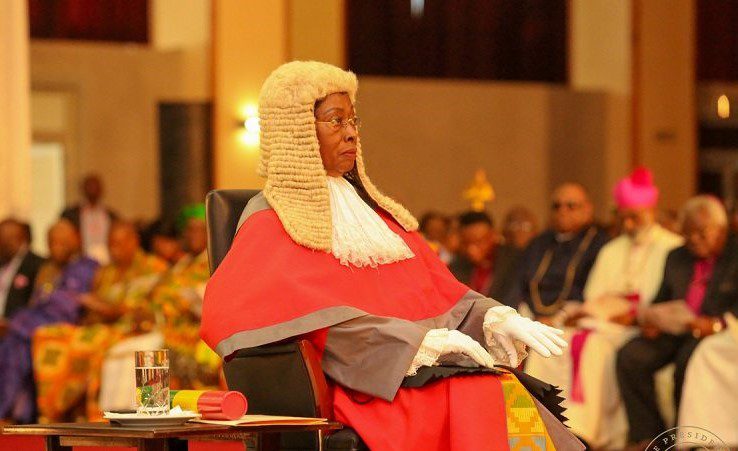
Former Director of the Ghana School of Law, Dr Ansa-Asare, has described the Council of State as “100% partisan,” arguing that the constitutional advisory body no longer provides the independent thought and balanced perspectives it was designed to offer.
His comments come amid discussions surrounding the resignation of former Chief Justice Sophia Akuffo from the Council of State and the challenges associated with finding a replacement.
Get more exclusive breaking news updates on our WhatsApp channel .
According to Dr Ansa-Asare, the composition of the Council under Article 89 of the Constitution has created an environment where independent thinkers are unable to freely express their views.
He argued that members with dissenting opinions often find themselves isolated, hounded out, or compelled to remove themselves from the institution altogether.

“The Council of State is now 100% partisan,” he stated, adding that the body has drifted away from its intended role as a repository of wisdom and independent counsel.
Dr Ansa-Asare also raised concerns about the circumstances surrounding Sophia Akuffo’s resignation.
He questioned the government’s handling of the matter, claiming that although Akuffo reportedly resigned in September, the public was not informed until much later.
According to him, the delay amounted to the government being “economical with the truth” regarding the vacancy.
The former law lecturer further suggested that the former Chief Justice’s position on the Council became increasingly difficult following her dissent in high-profile proceedings.
He argued that her resignation could be interpreted as a protest against an environment she found untenable, although he acknowledged that it could also have been a voluntary decision.
Dr Ansa-Asare also raised concerns over reports that Sophia Akuffo abstained from certain votes while serving on the Council.
As a member bound by an oath of secrecy, he argued that public knowledge of internal voting positions undermines the confidential nature of the institution and makes continued membership difficult.
Beyond the resignation, Dr Ansa-Asare criticised the process that led to Sophia Akuffo’s appointment to the Council in the first place.
He argued that former Chief Justice Georgina Wood, as the more senior retired Chief Justice, should have been given priority when the appointment was made.
While acknowledging that the Constitution does not explicitly require the most senior retired Chief Justice to be selected, he maintained that seniority is a fundamental principle within the legal profession and should have guided the decision.
According to him, bypassing Georgina Wood in favour of Sophia Akuffo ignored both legal tradition and common-sense constitutional interpretation.
The debate has now shifted to who should replace Madam Akuffo on the Council.
Dr Ansa-Asare noted that the pool of eligible retired Chief Justices is limited and that each potential candidate presents its own challenges.
He suggested that Georgina Wood may be reluctant to serve after previously being overlooked, while concerns have also been raised regarding other potential candidates.
He further argued that partisan considerations have complicated the selection process, making it difficult for any President to identify a replacement capable of working harmoniously within the existing political environment.
Dr Ansa-Asare called for constitutional reforms to ensure the Council of State reflects a broader range of views and opinions.
According to him, the institution can only function effectively if it accommodates all shades of opinion rather than operating as a politically aligned body.