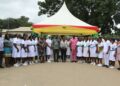
A National HIV Response Sustainability Assessment and Roadmap (Part A) was launched on Tuesday in Accra to guide Ghana toward long-term financing and nationally owned management of the country’s HIV response. Developed with technical support from UNAIDS, the roadmap outlines priorities such as strengthening domestic resource mobilisation as Ghana works toward ending AIDS as a public health threat by 2030.
Dr. Agnes Naa Momo Lartey, Minister for Gender, Children and Social Protection, highlighted the need to transition from reliance on external funding to a sustainable, nationally owned HIV response. “For over two decades, Ghana has made remarkable progress in reducing new HIV infections and ensuring that persons living with HIV can access treatment and live with dignity. What we need now is sustainable funding,” she said, emphasising the government’s commitment to promoting inclusivity among women, children, and key populations who continue to face vulnerabilities.
Get more exclusive breaking news updates on our WhatsApp channel .
Dr. Lartey further noted that her ministry would continue collaborating with the Ghana AIDS Commission (GAC), civil society organisations, and community networks to ensure social protection interventions address the lived experiences of people living with HIV.
UNAIDS Country Director for Ghana, Mr. Hector Sucilla Perez, said the roadmap provides a compass for navigating a challenging global financial environment where international assistance for HIV is declining while demand for treatment, prevention, and social protection continues to grow. “Sustainability is not only about money. It is about ownership—making strategic choices to integrate HIV into national priorities, protect vulnerable populations, and make every cedi count,” he said, noting that the document aligns with Ghana’s broader political priorities and the Accra Reset initiative, which calls for innovative approaches to financing health and development.

Mr. Perez stressed that sustainable financing must guarantee continued access to HIV testing, treatment, care, and prevention, while encouraging adoption of new innovations, including pre-exposure prophylaxis (PrEP) with lenacapavir.
Ghana faces a generalised HIV epidemic, with an estimated 334,000 people living with HIV in 2023, representing a 1.53 per cent prevalence among adults aged 15–49. Data from GAC shows that in 2024, the total number of people living with HIV (PLHIV) is estimated at 334,721, including 18,229 children under 15 and 316,492 adults. Annual new infections have declined from 21,000 in 2020 to 15,290 in 2024, while treatment cascade results improved slightly from 67-69-89 in 2023 to 68-69-90 in 2024, though significant gaps in diagnosis and treatment initiation remain.
Ghana’s HIV response has long depended on donor support, with 60 per cent of funding coming from international partners such as the Global Fund and PEPFAR. However, external financing is expected to decline following recent aid cuts, widening Ghana’s $590 million funding gap projected between 2023 and 2030. Stakeholders estimate that achieving the 2030 targets will require approximately $258 million annually, more than double current funding levels.