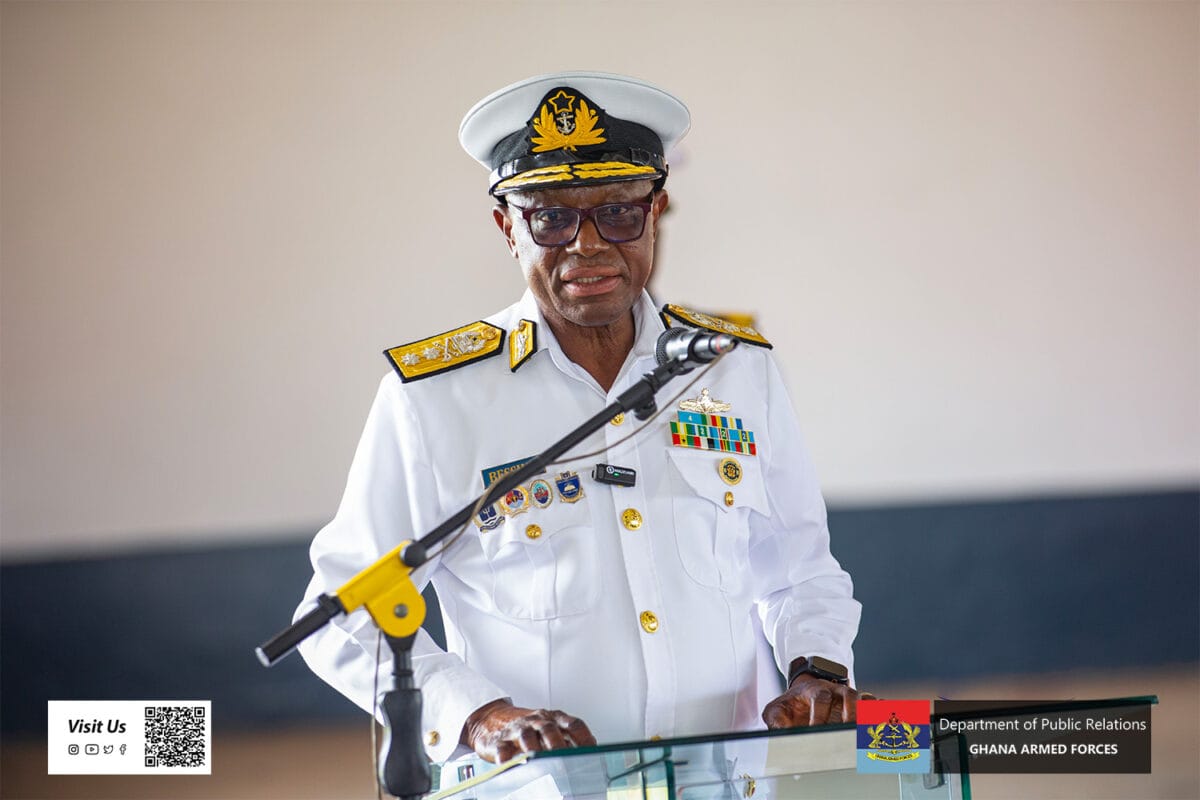
Accra, Oct. 8, Rear Admiral Livinus Bessing, Chief of Naval Staff, has called on the media to amplify advocacy efforts urging government to adequately resource the Ghana Navy to safeguard the country’s maritime domain.
Speaking at the opening of a three-day training workshop for journalists on maritime security, safety, and the blue economy in the Gulf of Guinea, Rear Admiral Bessing said the Navy’s operational challenges were largely due to inadequate logistics, not lack of competence.
Get more exclusive breaking news updates on our WhatsApp channel .
The training was organised by the European Union-Enhanced Maritime Action in the Gulf of Guinea (ENMAR) and the Gulf of Guinea Maritime Institute (GoGMI), funded by the European Union and implemented by Expertise France.
Rear Admiral Bessing cited a recent case in which a French Navy vessel intercepted over 10 tonnes of narcotic drugs in Ghanaian waters, attributing the success to better resourcing. “It’s not because we do not know how to do our work; we simply don’t have the needed tools,” he said.

He stressed the importance of media advocacy in drawing government attention to maritime security needs, noting that activities at sea often go unnoticed because they are far from public view. “The maritime environment is quite distant from the shoreline, and several things happen on the blind side of everyone,” he added.
Rear Admiral Bessing said Ghana loses about $200 million annually to Illegal, Unreported and Unregulated (IUU) fishing and other maritime crimes, which the Navy could better address with proper equipment. He lamented that since 2010, the Navy’s request for two Offshore Patrol Vessels (OPVs), each costing under $200 million, has not been fulfilled.
“This project has gone through several governments, but we are yet to get it. You can imagine from 2010 till now, 200 million times 15 could have bought us several of the platforms. This is the sort of advocacy I wish to challenge you with,” he told the media.
He urged journalists to engage the Navy for information on maritime threats such as piracy and drug trafficking to help generate public and policy support for better resourcing.
Mr. Albert K. Dwumfour, President of the Ghana Journalists Association (GJA), in a keynote address, reaffirmed Ghana’s commitment to maritime safety and regional security in the Gulf of Guinea. He noted that journalists play a crucial role in making maritime issues visible to the public and policymakers.
“When journalists make these issues visible and explain the human cost of illegal fishing, the risks of piracy, or the promise of a thriving blue economy, they hold leaders accountable and create conditions for better ocean governance,” Mr. Dwumfour stated.
He encouraged journalists to approach maritime reporting as part of Ghana’s broader national and regional development narrative. “The maritime story is a Ghanaian story, a West African story, and ultimately a story about human security and sustainable development,” he said, underscoring the need for diverse voices in ocean governance discourse.