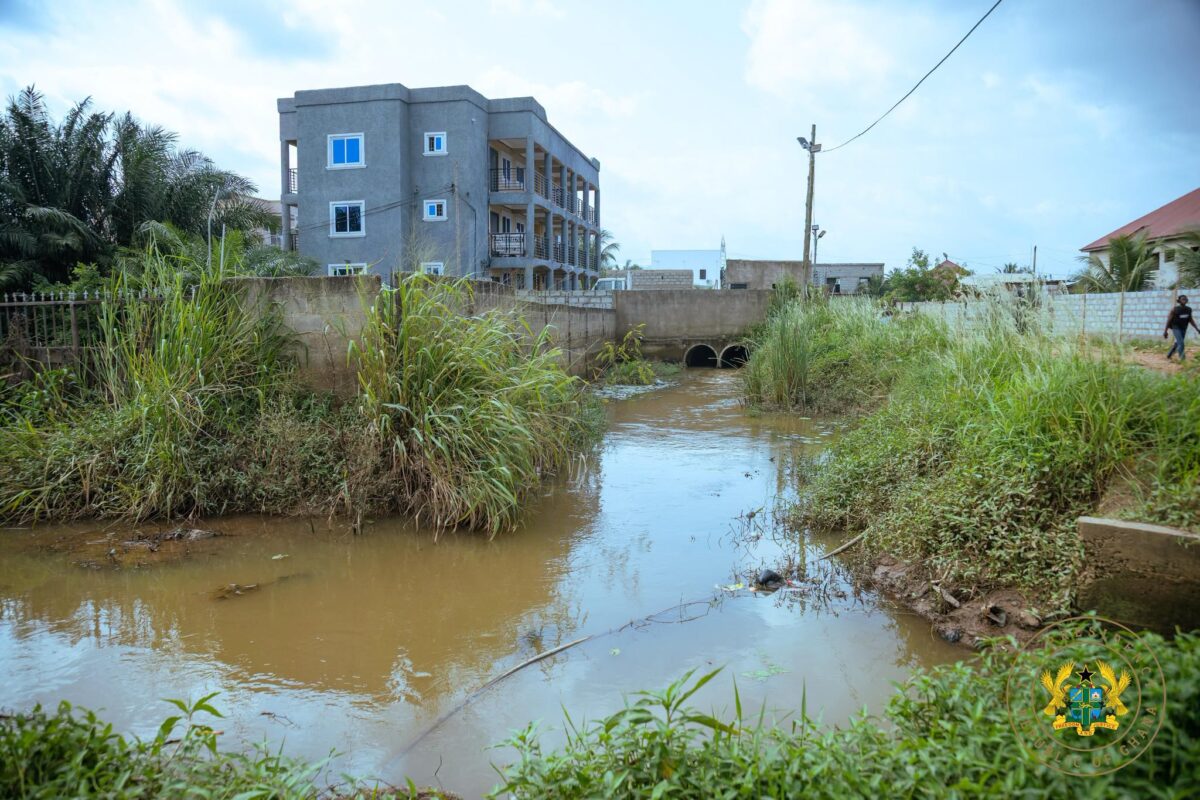
Accra’s perennial flooding problem has once again taken centre stage as the Flood Mitigation Task Force releases a damning report on the state of the Tesa Dam, located adjacent to Boundary Road.
The findings reveal rampant encroachment that has severely compromised the dam’s capacity, posing serious risks to surrounding communities during the rainy season.
Get more exclusive breaking news updates on our WhatsApp channel .
The task force’s inspection highlights a troubling pattern of illegal activities that have diminished the dam’s size and functionality.
Encroachers have not only reduced the water body’s expanse but have also constructed unauthorised retention walls, many of which have now been marked for demolition.

Additionally, a nearby slum area filled with overcrowded wooden structures presents significant health and sanitation hazards, further complicating efforts to manage flood risks effectively.
Tesa Dam, like many water bodies in the Greater Accra Region, was designed to serve as a critical buffer against flooding by storing excess rainwater and regulating flow.
However, years of unchecked human activity have turned it into a shadow of its intended purpose. Illegal retention walls built by encroachers obstruct natural water flow, while the shrinking dam size reduces its storage capacity dramatically.
The presence of a slum settlement nearby exacerbates the situation. Overcrowded wooden structures not only occupy land meant for buffer zones but also create poor sanitation conditions.
Waste disposal issues, open defecation risks, and limited access to basic services turn the area into a potential public health crisis, especially when flooding occurs and contaminates water sources.
The Flood Mitigation Task Force has earmarked the affected areas for demolition, signalling a renewed push by authorities to reclaim these vital spaces.
This move aligns with broader government and local assembly efforts to enforce building regulations and restore natural drainage systems across flood-prone zones in Accra.
Accra’s rapid urbanisation has fueled a housing deficit that drives many residents toward informal settlements. Economic pressures, population growth, and weak enforcement of land-use laws create fertile ground for encroachers.
Water bodies and wetlands are particularly vulnerable because they are often viewed as “unused” public land by opportunists.
Previous administrations and city authorities have launched demolition exercises.
Weak monitoring, limited resources for continuous surveillance, political and economic interests, and poverty-driven informal settlements have allowed the problem to persist despite repeated interventions.
Climate change, marked by more intense rainfall, reduced green spaces, and blocked drainage systems, has further worsened the situation and increased flood risks.
The task force’s report serves as a wake-up call. Without decisive action, the upcoming rainy season could bring renewed disaster to neighbourhoods already scarred by past floods.
Flooding in Accra is not merely an inconvenience; it is a multifaceted crisis affecting lives, property, the economy, and public health. Each major flood event results in deaths, displacement, destroyed infrastructure, and outbreaks of waterborne diseases. Businesses suffer, traffic grinds to a halt, and the city’s development trajectory is hindered.
Restoring water bodies such as Tesa Dam is a key pillar of effective flood mitigation.
Complementary measures include desilting and expanding drainage systems, strictly enforcing zoning laws, investing in sustainable urban planning and green infrastructure, relocating and resettling affected communities with proper support rather than mere demolition, and public education on the dangers of building in waterways and floodplains.
The involvement of a dedicated Flood Mitigation Task Force indicates heightened governmental attention. However, success will depend on transparency, community engagement, and follow-through to prevent the cycle from repeating.
Residents near Tesa Dam and similar sites often express frustration with both encroachers and authorities. While some sympathise with the plight of slum dwellers, most acknowledge the necessity of clearing hazardous structures to safeguard the wider public.
Experts recommend a holistic approach: combining enforcement with social support programmes, providing alternative housing or livelihood opportunities for displaced persons, and using modern technology such as satellite monitoring, GIS mapping, and community reporting apps to strengthen enforcement efforts.
The task force’s identification of illegal retention walls for demolition is a positive step. Prompt execution, coupled with prevention of re-encroachment, will be critical. Long-term solutions must address root causes: affordable housing shortages, unemployment, and inadequate urban planning.
The Tesa Dam situation reflects a national challenge that requires collaboration among government agencies, local assemblies, traditional authorities, civil society, and citizens. Media outlets like GTV Ghana play a vital role in highlighting these issues, keeping public attention focused on accountability.
As Ghana experiences more extreme weather due to climate change, protecting natural buffers like dams, rivers, and wetlands is no longer optional; it is essential for urban resilience.
The Flood Mitigation Task Force’s report on Tesa Dam should catalyse urgent action before the next rains arrive.
For communities at risk, the message is clear: sustainable development cannot coexist with unchecked encroachment. Restoring Tesa Dam and similar sites offers hope for fewer flood-related tragedies and a safer, more resilient Accra.
The coming weeks and months will test the authorities’ resolve. Successful demolition and reclamation at Tesa Dam could set a precedent for other vulnerable areas. Failure to act decisively, however, would condemn residents to another season of avoidable suffering.