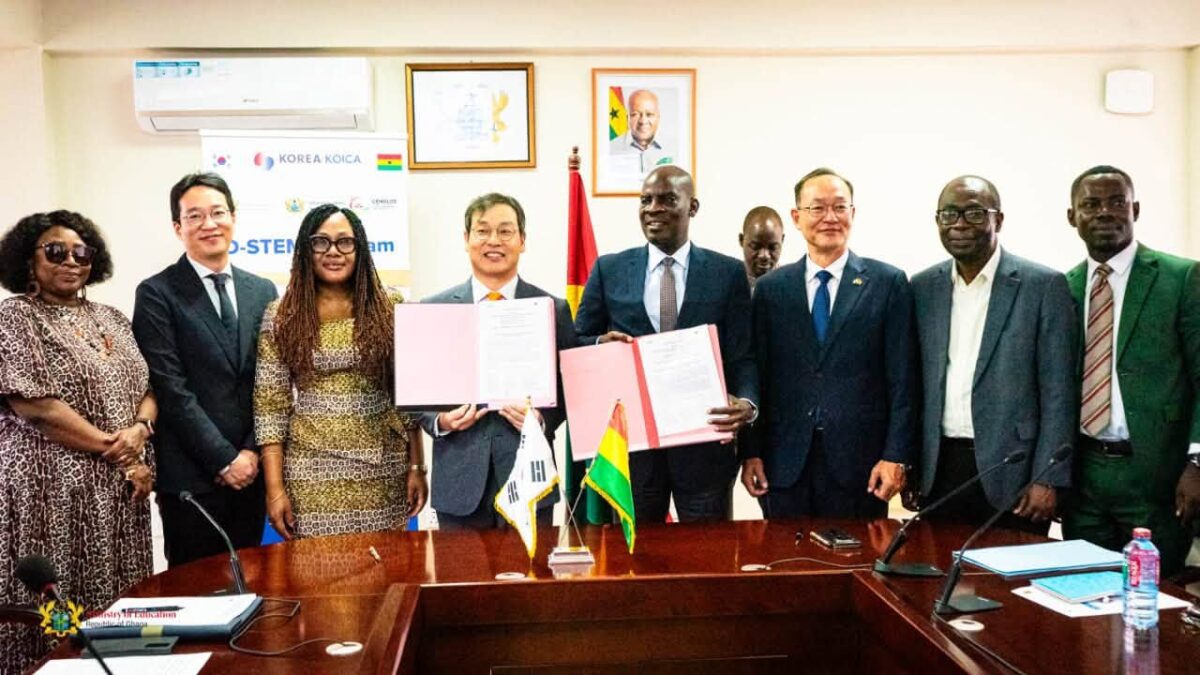
The Governments of Ghana and the Republic of Korea have signed a Memorandum of Understanding (MoU) for the second phase of the Digital STEM Education Project.
The Republic of Korea has committed US$28 million to support the six-year initiative (2026–2032), which aims to significantly strengthen digital Science, Technology, Engineering, and Mathematics (STEM) education across key regions in Ghana.
Get more exclusive breaking news updates on our WhatsApp channel .
The second phase will expand interventions to the Central, Eastern, Ashanti, and Northern regions.
Major activities include construction of the Accra STEM Park, strengthening the Northern STEM Resource Centre, integration of digital technologies into STEM teaching and learning, and introduction of practical skills such as robotics, coding, electronics, and artificial intelligence at the basic education level.

Speaking at the signing ceremony, the Minister for Education, Hon. Haruna Iddrisu, described education as the foundation of national development.
He emphasised that the project would equip Ghanaian learners with critical digital skills needed for the 21st-century economy. The Minister also announced that the Ministry would roll out a revised curriculum for kindergarten to junior high school before September 30, with digital education as a core component.
Hon. Haruna Iddrisu expressed profound appreciation to the Government of the Republic of Korea and the Korea International Cooperation Agency (KOICA) for their consistent support to Ghana’s education sector.
The Korean Ambassador to Ghana, Park Kyongsig, and KOICA Country Director, Dong Hyun Lee, reaffirmed their strong commitment to the partnership and expressed confidence in the successful implementation of the project.
This collaboration comes at a critical time as Ghana seeks to build a knowledge-based economy.
Strong STEM education is essential for driving innovation and technological advancement, addressing skills gaps in key sectors, enhancing competitiveness in the digital age, and supporting industrialisation and economic transformation.
The focus on basic education ensures that foundational skills are built early.
The US$28 million investment from South Korea demonstrates the value of strategic international partnerships in advancing national development priorities.
The Digital STEM Education Project is expected to benefit thousands of students, teachers, and schools while laying a solid foundation for long-term educational excellence.