The Minority New Patriotic Party (NPP) has delivered what it calls the “True State of the Nation” address, challenging the accuracy of President John Dramani Mahama’s recent presentation to Parliament.
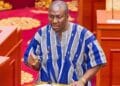
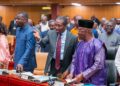


According to the Minority caucus, the President’s address did not reflect the true state of affairs in the country.
Get more exclusive breaking news updates on our WhatsApp channel .
Below is the full speech delivered by former Finance Minister Dr. Mohammed Amin Adam.
THE TRUE STATE OF THE NATION ADDRESS BY THE NPP MINORITY CAUCUS IN PARLIAMENT AT PARLIAMENT HOUSE – 3RD MARCH 2025
Throughout the SONA, the President did well to explain to the nation his vision for education. His commitment to continue the implementation of Free School High School (FSHS) is commendable. We also commend his commitment to continue President Akuffo Addo’s drive to boost the Tertiary Gross Enrolment Ratio. Besides these, however, the vision espoused by President Mahama is uninspiring, exposing a profound education best practice and knowledge gap. Clearly, the President’s speech lacked coherence and did not articulate clearly the role of education in the transformation of Ghana. Many of the initiatives announced are already being implemented with a high degree of success under the previous regime. Consequently, a number of reforms have taken place across all levels of education in Ghana including tackling the learning crisis in the early years of education, through the implementation of of Differentiated Learning approach (Foundational Learning).

In the face of COVID-19, teachers and other education workers came together and saved our nation from what could have been catastrophic learning losses. By working together, our Primary 2 literacy jumped from 2 percent in 2015 to 38 percent in 2022.
To equip learners with 21st-century skills at the secondary level. The Ministry of Education under Akufo-Addo’s administration had a total overhaul of the country’s secondary education curriculum with a focus on improving national values, promoting STEM education, and preparing learners for the field of work.
To make sure that our students meet global standards and participate in the fast growth of digitalization, advancing STEM education for Ghana’s transformation was a key focus in our government. Thus, 13 STEM schools have been built across the nation. These include Awaso STEM SHS, Koase STEM High, East Legon STEM Academy, Kpasenkpe STEM SHS, Bosomtwe STEM and Girls SHS, and so on. In 16 addition to that, over 20 STEM centres have been built in existing schools across the country.
Contrary to the assertion that the Ghanaian education system is outmoded, we have rather enhanced our education system during the last few years. An education system that has introduced courses like biomedical sciences, engineering, aviation, manufacturing engineering, robotics, and so on. We have also built science and engineering labs across the country. This system of education cannot be described as outmoded. As we speak, high school students are receiving tablets to facilitate technology integration to enhance teaching and learning under the Ghana Smart Schools Project introduced to empower students on a global scale.
While His Excellency John Dramani Mahama has outlined his vision for education and skills development, it is imperative to acknowledge the substantial progress made under the previous administration in transforming Technical and Vocational Education and Training (TVET) in Ghana.
In 2017 The TVET sector was uncoordinated, and some seventeen (17) Ministries were engaged in some form of TVET regulation and delivery and therefore made coordination across the landscape quite challenging since each of the TVET Institutions were taking direct instructions from their ministries and legislations. Almost all the workshops in the TVET Institutions were filled with obsolete tools and equipment and outdated curricula.
The sector was not responsive to the needs of Industry. The linkage between training providers and industry was very weak which caused mismatches in the demand and supply.
The Akufo-Addo led government implemented bold reforms, backed by significant investments, to revamp TVET, ensuring it becomes a viable pathway for skills acquisition, entrepreneurship, and employment creation.
Some of the key interventions and accomplishments in the sector included the establishment of the Commission for TVET (CTVET) and the Ghana TVET Service (GTVET), introduction of Free TVET into the Free Senior High School (Free SHS) policy leading to a massive jump in 3-year enrolment from 41,696 in 2016 to over 172,473 in 2024, construction of four new TVET centres of excellence, rehabilitation and Equipping of tertiary and pre-tertiary TVET Institutions, implementation of Competency-Based Training (CBT), Establishment of Sector Skills Bodies (SSBs) to bridge the gap between training institutions and industry, introduction of the National Apprenticeship Policy and Ghana Apprenticeship Programme (GAP) with over 40,000 beneficiaries, Strengthening of TVET Teacher Training by establishing the Akenten Appiah Menkah University for Skills Training and Entrepreneurial Development (AAMUSTED), Establishment and Operationalization of the Ghana Skills Development Fund (GSDF), introduction of STEM-Integrated TVET Centres, TVET Curriculum Reforms with over 108 CBT curriculum packages developed, introduction of World Skills Ghana and joining as the 81st member, and initiated the construction of 32 new state of the art TVET centers (two per a region).
We have laid a solid foundation for TVET transformation in Ghana. The focus should now be on consolidating these gains rather than presenting an inaccurate narrative that disregards these achievements. The future of TVET in Ghana depends on building upon these robust interventions to further enhance skills development and economic growth based on our proposed TVET policy that focuses on just transition, governance, access, quality, sustainable and efficient financing, research and innovation, competency based training and environmental sustainability.
The previous NPP government focused on equipping learners at all levels with 21st century skills so that learners can be partakers of the 4th Industrial Revolution.
However, it’s quite appalling to hear President Mahama say that they inherited an outdated system.