



Accra High School, one of Ghana’s most historic senior high schools, is now in the spotlight for deeply disturbing reasons.
Over recent weeks, Online Times has received testimonies and audio recordings from students and insiders who describe an environment defined not by learning, but by fear, intimidation and systemic neglect.
Get more exclusive breaking news updates on our WhatsApp channel .
These accounts reveal a school where physical assault is normalized, victims are silenced and even allegations of sexual violence struggle to receive basic institutional attention.
All of this unfolds in a country whose 1992 Constitution and Children’s Act mandate that every child be treated with dignity and protected from any form of abuse, rights that students at Accra High say are routinely violated.

A Headmistress Shielded by Power, Politics and Bureaucracy
For three and a half years, Accra High School has been under the leadership of Ms. Evelyn Sagbil Nabia, a headmistress whom students and staff describe as ruling through fear.
Teachers recount moments where raising legitimate concerns was met not with dialogue, but with threats and retaliation.
Some allege that Ms. Nabia frequently invokes her political connections, including an unverified claim that she attended school with the Minister for Education, Hon. Haruna Iddrisu, which creates the perception that she is insulated from accountability.
Her previous tenure at Sawla Senior High School reportedly ended in crisis after conflicts with both staff and students. Teachers at Accra High fear that the same trajectory is unfolding again.
A senior staff member described the environment as suffocating, saying everyone moves carefully, afraid that even reporting misconduct could lead to punishment rather than reform.
When Online Times contacted her to seek and verify the current reports we have received from the students and a whistleblower. She indicated that the case is being investigated by the Ghana Education Service and cannot comment on it.
“The case is currently under investigation; hence, I am unable to make a statement on it”
A Culture of Violent Punishment, and the Students Who Paid the Price
Despite the GES ban on corporal punishment, numerous students say physical abuse persists.
According to the former and current students’ audio recordings that reached Online Times, they indicated being slapped, insulted or humiliated by staff members, and in major scenarios by the headmistress herself.
What is worse is that several victims described the incidents as painful and have been left in fear.
One female student who attempted suicide after allegedly being slapped by the headmistress sent a voice note to a friend the same night, whispering through tears:
“I can’t breathe well. My cheek is swollen. I don’t know what I did wrong. I just want to disappear.”
According to the student, she wrote a petition to the Ghana Education Service. When the headmistress found out, she came to ask her why she did that behind her, thinking it would go without her notice.
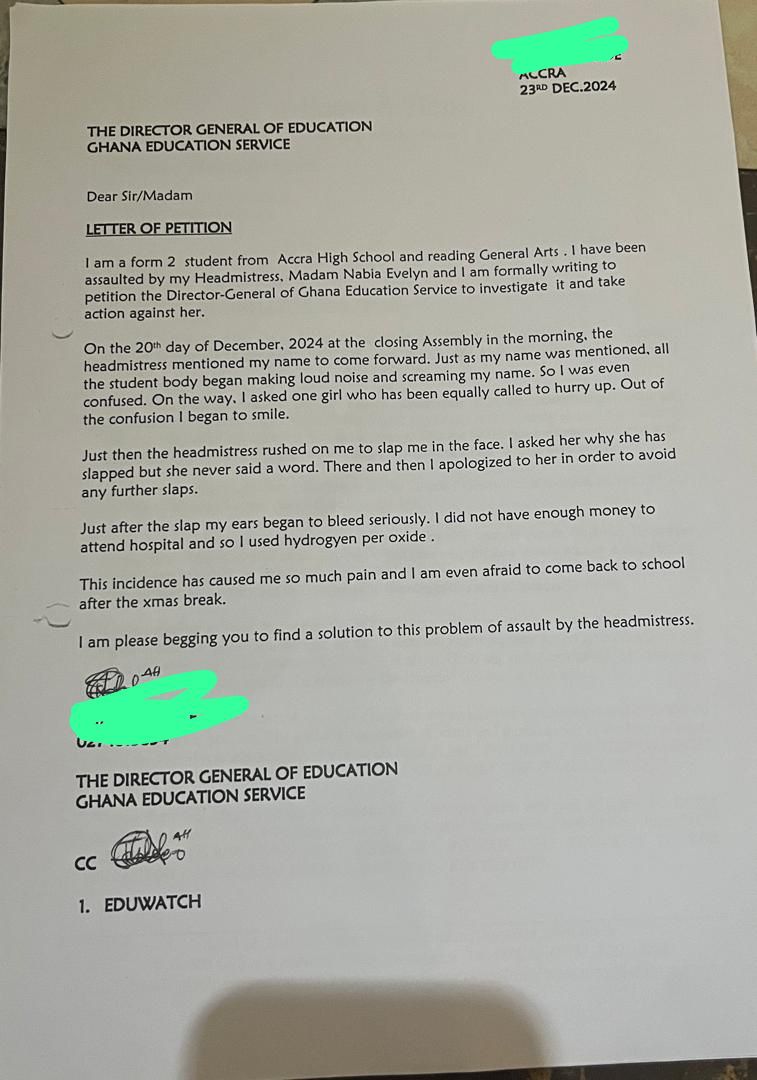
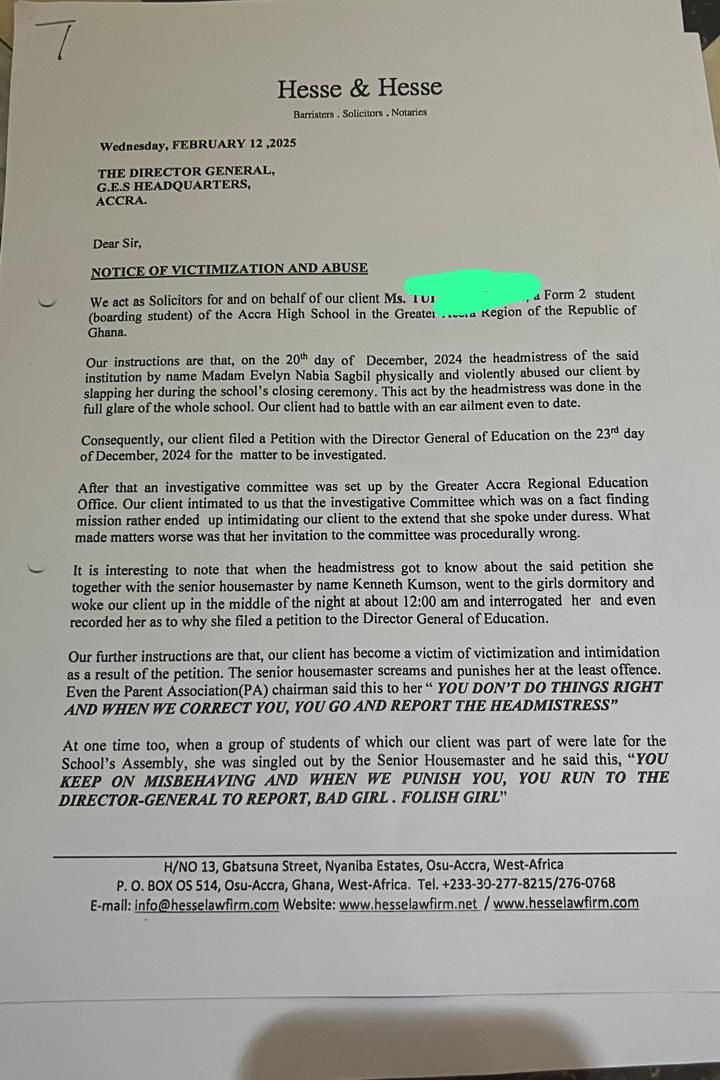
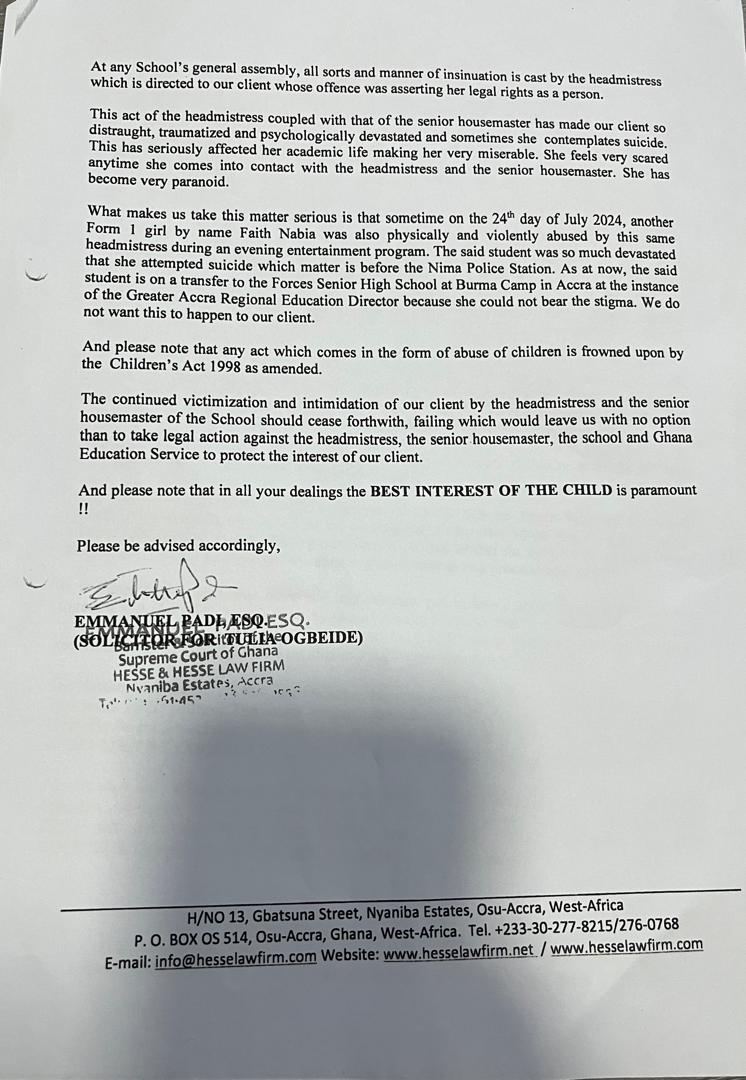
Another student, a boy who says he was slapped multiple times by a staff member called Mr Koomson, also known as (Asumbo), can be heard in an audio recording sobbing and breathing heavily. His voice cracks as he struggles to speak:
“Sir… he hit me, and my nose started bleeding. I told him I didn’t do anything. He didn’t stop.”
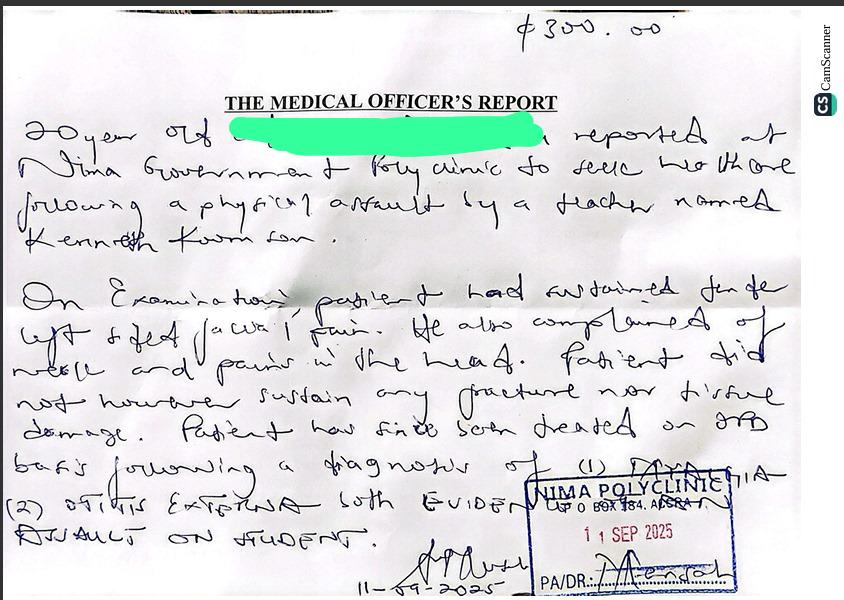
A popular former basketball captain for the school, who left the team, recorded an emotional message to a teammate describing how repeated slaps affected him:
“I can’t even focus on class. Every time he raises his hand, I flinch. I’m tired. I don’t want to be here anymore.”
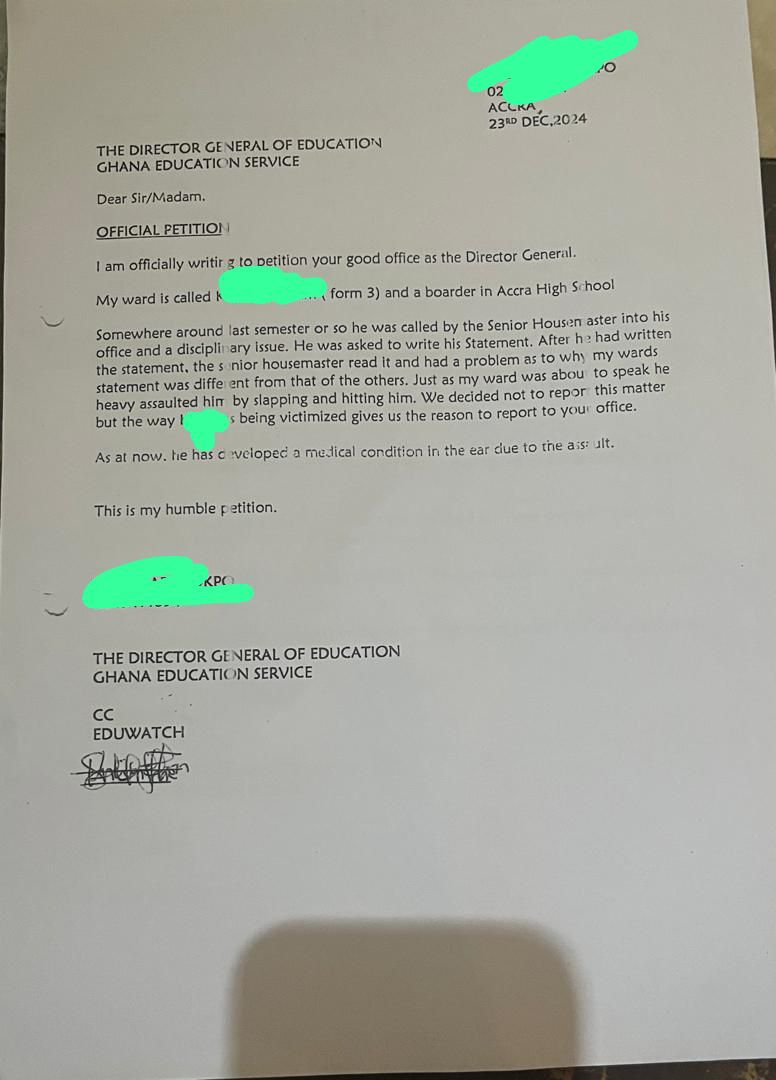
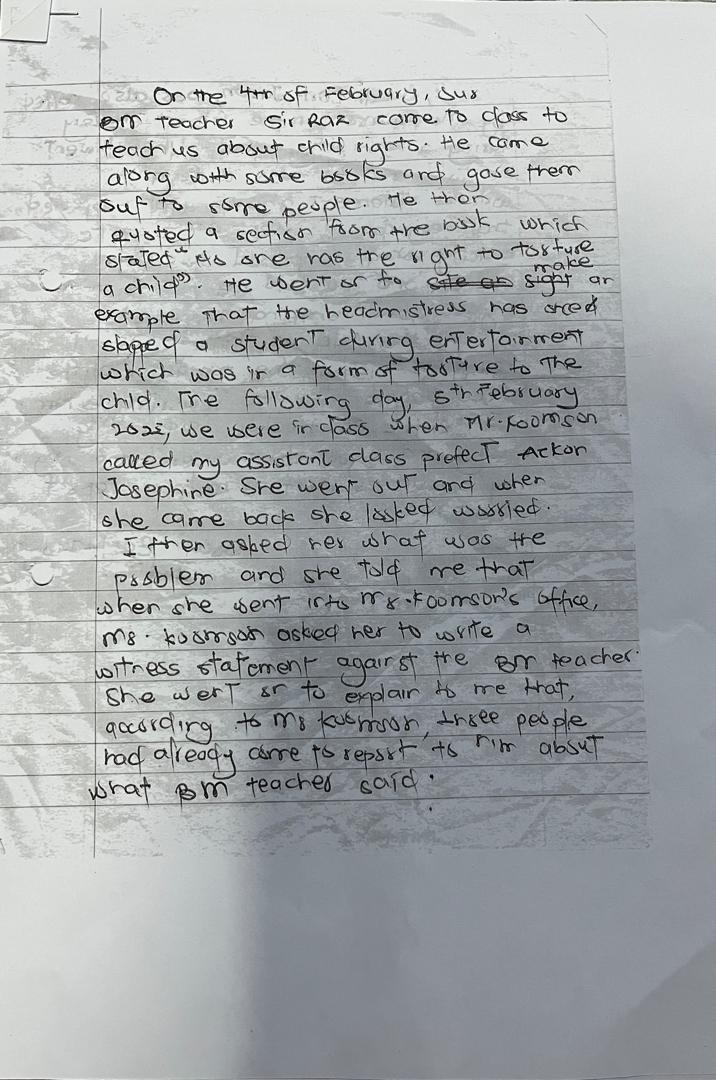
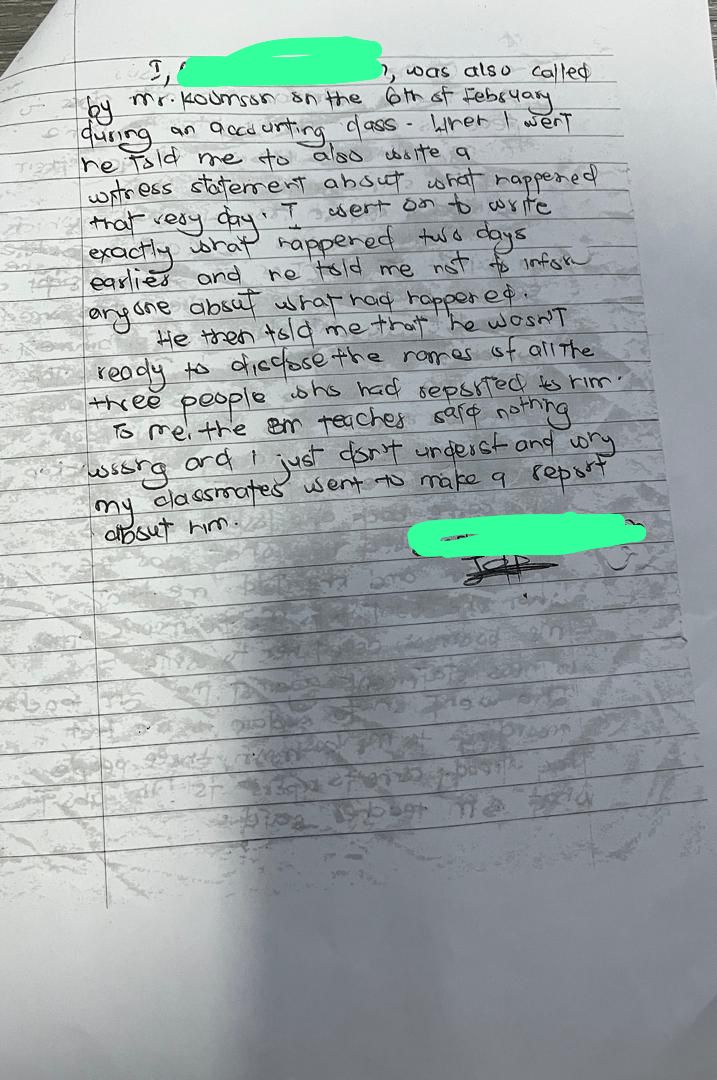
Multiple girls also say that reporting being slapped or verbally assaulted led to their own punishment. One of them recounts in a voice note:
“When I told them what happened, they said I was rude. They made me stand for hours. I wish I had never reported.”
A former male student who completed in 2021 gave his account of receiving a slap without a reason. According to him, he was going to save a student who was being bullied; however, when Mr Koomson arrived there, he just slapped him
“I received a slap for no reason… this happened in the year 2021, during the period of our mock exams. I saw a colleague bullying another student. I went there to intervene, and I received a slap without explanation”
A former female student, who also received a slap because she came late for a social gathering at the school, was asked to stand in front of the whole student at the assembly ground, for hours, even when the assembly was over, the headmistress descended from her office and slapped her across her face
“Without asking me what I did, the headmistress slapped me across my face and was threatening to receive more of the slaps if I committed again. Also, I had a dorm mate who was slapped six times for sharing her bed with a colleague.”
Students like Ama and Abena (Name withheld) became well-known examples, not for the abuse they reported, but for the punishment that followed.
Ama’s attempted suicide was discussed quietly among students, with her voice note circulating as a cautionary tale. Abena’s tearful audio message to a relative described the fear of being deboardinized after trying to speak up.
The Rape Case the School Tried to Bury
The most harrowing piece of evidence obtained by Online Times is an audio recording made by a 16-year-old student shortly after she says she was raped by her teacher, Mr. Faisal Adamu Kwame.
In the shaky voice note, recorded while she cried uncontrollably, she says:
“I told him I was bleeding. I begged him. I told him, ‘Please, sir, please.’ He closed the window. He pushed me. He held my neck. I couldn’t scream. I was in pain. I was bleeding when I left the room.”
The rawness of her voice, the pauses as she tries to steady her breath and the tremors in her narration paint a heartbreaking portrait of fear and helplessness.
Despite reporting the matter, she says her statement was never properly taken, and she never received counselling. She explains in another audio:
“I kept asking them what is happening to my case. Nobody told me anything. I saw him on campus. I feel like committing suicide because I don’t feel safe.”
Her family reported the matter to DOVVSU at the Nima Police Station, but they say follow-ups have yielded little progress.
Another Sexual Misconduct Scandal, and Another Student Facing Punishment
On Wednesday, 12th November 2025, a new case of alleged sexual misconduct shattered the fragile calm on campus.
According to teachers and students, a staff member identified as Mr. Ansa was confronted by four men after a girl accused him of inappropriate sexual touching, including allegedly “fingering” students in the staff common room.
The incident led to a report at the Nima Police Station, but within two days, the student who made the allegation was summoned by the school’s disciplinary committee. Our source believes she may face suspension while the accused teacher remains on duty.
Our Source also describes the situation as part of a long-standing pattern: the institution protects itself, not the victims.
A System Designed to Silence Victims and Protect Power
Many students say they feel trapped, with no safe avenue for reporting abuse. Parents in the PTA allegedly fear that pushing too hard could make their children targets.
Our Source claims the Old Students Association often sides with the administration and dismisses abuse reports as indiscipline.
And parents who attempt to challenge the system reportedly risk having their children deboardinized or intimidated.
One former alumni PRO captured the situation succinctly, telling Online Times that within the school’s culture, “the student is always wrong,” a mentality that leaves victims isolated and predators shielded by institutional loyalty.
The Law Is Clear, but Enforcement Is Missing
Ghana’s legal framework is unambiguous. The 1992 Constitution affirms the inviolable dignity of all persons, and Article 28(1)(d) guarantees every child protection from physical or psychological harm.
The Children’s Act explicitly bans cruel or degrading treatment of minors.
RelatedNews


Yet the accounts emerging from Accra High suggest a severe failure of enforcement, leaving students unprotected despite clear constitutional safeguards.
A School on the Brink of Crisis
Some concerned teachers warn that Accra High is approaching the same crisis point that marked the end of Ms. Nabia’s tenure at Sawla SHS. The environment is tense, fragile and increasingly volatile. Students are emotionally exhausted and feel unsafe. And misconduct cases keep piling up without transparent resolution.
Our source described the current atmosphere as “the silence before an explosion,” noting that everyone can feel that something is about to break.
Unanswered Questions That Authorities Must Now Confront
- Why were allegations of rape and sexual misconduct not escalated through transparent and timely investigative channels?
- Why were students who reported abuse allegedly punished or deboardinized instead of being protected?
- Why do some teachers accused of assault continue to work around children?
- What structures exist to prevent administrative power or political influence from shielding accused individuals?
- Why has no independent investigative committee been deployed despite years of serious allegations?
A Final Reflection: When Children Cry for Help, Who Will Listen?
The allegations at Accra High School reveal a painful truth about the state of child protection in Ghana’s educational institutions.
They show a system where fear triumphs over justice, where victims must whisper their pain into voice notes because formal channels fail them, and where the adults charged with safeguarding students instead wield power as a weapon.
If these testimonies, these voices trembling with fear, grief and betrayal, do not trigger urgent intervention, then Ghana must confront a heartbreaking question about the cost of silence.
Schools are meant to shape futures, not shatter them. And until the voices of these children are heard, believed and protected, the crisis at Accra High will remain not just a school issue, but a national one.





It’s so sad that all these are happening at Accra High school, and the fact that this did not start today is questionable. I completed Accra high school in 2023 and even during our time, issues of intimidation and unfair punishments were prevalent
Mostly teachers would complain and side with students in the absence of the administration but by some magic means would turn in support of the administration members when the matter is being handled in their presence ie. The administration.
Ms Nabia has been a disciplinarian and that in a way helped the school but most of her actions and decisions caused the school so much, as someone who was close to two or three senior prefects during her tenure, i saw and heard abuses from her as the headmistress even against the senior head prefects and some of them even had their academics affected due to the intimidation and frustration some of these actions caused. We were told most of the old students sided with her and for that matter she did whatever she did with least fear of removal or punishment and to our amazement after over two years of our completion we still see reports of abuses which are neglected and no actions are taking. About the senior house master, it is so strange that he could slap anyone whenever he wanted and no one dared to correct when his bases for the slap was wrong hence earning the nickname ’Asumbo’. I will encourage your firm and the barristers who are handling the cases at hand to fight through every thin and thick details to find justice for the students and if possible dissolve the administration and temporal school board, this i think will help eradicate everyone within these executive who has caused the mayhem at the school
Thank you for your report