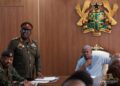
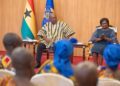
President John Dramani Mahama has stated that the reversal of United States visa restrictions on Ghana was achieved in the country’s best interest. He made the remarks while formally commissioning 11 new envoys at the Presidency in Accra.
“Many of you are aware that Ghana became the only country subject to US visa restrictions to secure a complete reversal from the Trump administration,” President Mahama said. “Let me state clearly that this outcome was negotiated in Ghana’s best interest.”
Get more exclusive breaking news updates on our WhatsApp channel .
The President noted that a key point in the negotiations with US authorities involved addressing the issue of overstayers—Ghanaians who travel on student visas or as part of official government delegations but fail to return home. “These are people who go, and instead of coming back, they decide to stay. When they draw the threshold and you’re above it, then they cancel your five-year visas and bring you to B-5, B-3,” he explained. He urged Ghanaians applying for visas to return as required, warning that overstaying affects the broader population.
President Mahama emphasised that no financial considerations were part of the understanding with the United States. He added that negotiations are ongoing regarding trade tariffs of 15 per cent and the renewal of the Africa Growth Opportunity Act (AGOA), which provides zero-tariff access to the US market for African nations. AGOA aims to support the economies of sub-Saharan Africa and strengthen economic relations with the United States.

“I wish to assure my countrymen and women that our understanding with the US does not undermine our sovereignty, security, or stability,” President Mahama said. “Ghana will not, and I repeat, will not become a dumping ground for deportees, nor will we accept individuals with criminal backgrounds.”
He explained that the agreement with the US was limited, carefully vetted, and aligned with ECOWAS protocols, reflecting Ghana’s Pan-African commitment to regional cooperation while protecting the country’s dignity and sovereignty.
President Mahama urged the new envoys to communicate this clarity whenever questions arise. “Diplomacy involves more than just negotiation. It also encompasses managing perceptions and safeguarding your nation’s reputation,” he said.
Is this conversation helpful so far?