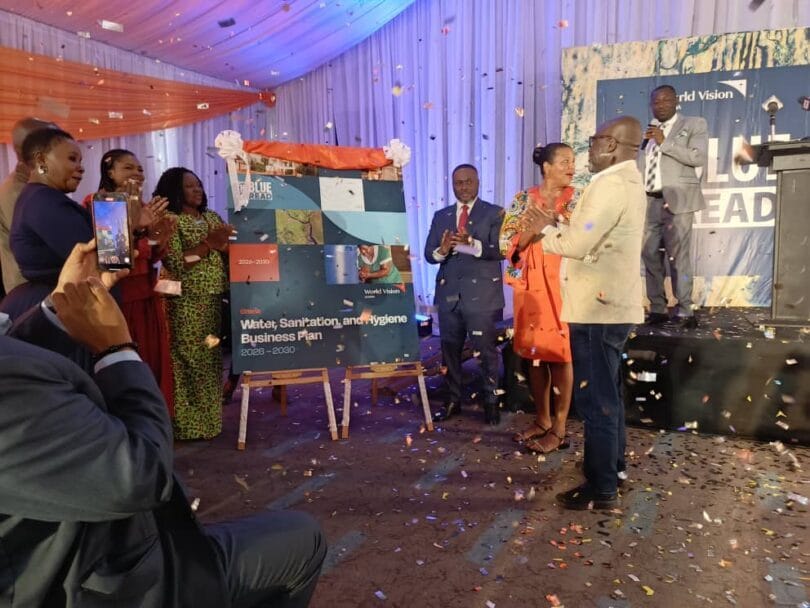
Works, Housing and Water Resources Minister Kenneth Gilbert Adjei has underscored the urgency of strengthening Ghana’s water systems as the backbone of community transformation, while endorsing World Vision Ghana’s (WVG) newly launched Water, Sanitation and Hygiene (WASH) Business Plan for 2026–2030.
The plan, unveiled in Accra under the theme “Mapping the Blue Thread”, commits US$51.7 million to expand WASH access for 743,000 children and their families across 23 administrative districts spanning the Upper West, Upper East, Savannah, Northern, Ahafo, Oti, Eastern, Ashanti, Central, Volta and Western North regions.
Get more exclusive breaking news updates on our WhatsApp channel .
Addressing stakeholders at the launch, Mr Adjei stressed that robust water systems remain a “connecting force” across sectors, directly influencing health, education and livelihoods.
While national access to basic water stands at roughly 90% and basic sanitation at 32%, he warned that climate change and illegal mining continue to endanger water sources.

He reiterated that sustainable progress hinges on collaboration, adding that the ministry is committed to partnering with all actors to ensure safe, reliable and affordable water services for every community. “Access to clean water promotes health, dignity and hope,” he emphasised.
World Vision Ghana’s new plan focuses on expanding and maintaining reliable water supply infrastructure, particularly in underserved communities, and scaling innovations such as solar-powered mechanised systems.
It also prioritises sanitation and hygiene behaviour-change initiatives, community capacity building, stronger accountability systems and long-term sustainability of facilities.
Deputy Minister of Local Government, Chieftaincy and Religious Affairs Rita Naa Odoley Sowah, speaking on behalf of Sector Minister Ahmed Ibrahim, expressed government’s appreciation to development partners and NGOs for driving progress in the WASH sector, assuring continued support to meet the plan’s targets.
WVG National Director Tinah Mukunda described the initiative as a major step towards achieving Sustainable Development Goal 6, clean water and sanitation for all, by 2030.
She noted that despite gains, significant gaps persist. Citing the 2021 Population and Household Survey, she said basic water access stood at 87.7%, while improved household toilet access was only 25.3%, with nearly 18% of households still practising open defecation.
Dr Mukunda called for stronger collaboration to turn universal WASH access from aspiration to reality. “Together, we are weaving the blue thread that connects health, education and economic empowerment,” she said. “The journey to universal coverage begins now.”