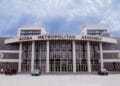
The Minority New Patriotic Party (NPP) has delivered what it calls the “True State of the Nation” address, challenging the accuracy of President John Dramani Mahama’s recent presentation to Parliament.
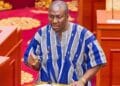
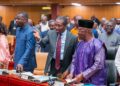


According to the Minority caucus, the President’s address did not reflect the true state of affairs in the country.
Get more exclusive breaking news updates on our WhatsApp channel .
Below is the full speech delivered by former Finance Minister Dr. Mohammed Amin Adam.
THE TRUE STATE OF THE NATION ADDRESS BY THE NPP MINORITY CAUCUS IN PARLIAMENT AT PARLIAMENT HOUSE – 3RD MARCH 2025
The President conveniently omitted from his address the strides made in the housing sector under the immediate past administration. This included the completion of some of the stalled projects inherited in 2017 like the Asokore Mampong housing project, resumption of works on the Adenta SHC estates and the selection of the private partner to commence work on the completion of the Saglemi project.

Additionally, 1000 homes were delivered to the security services, 1000 homes delivered by the TDC and nearly another 1000 homes by the State Housing Company. The Administration also set up the National Homeownership fund that has delivered about 500 homes so far.
The President failed to mention that the Ministry of Finance gave approval for GIIF to set up a GIIF Housing sub-fund to receive funding for bankable housing projects while the Ministry of Housing rolled out a PPP framework to stimulate housing. These strides made in the housing sector marked an unprecedented change in the approach to resolving the housing deficit in Ghana. Instead of seeking to lambast the outgone administration, credit should rather be given to it followed by a commitment to build on it.
The Ghana Priority Health Infrastructure Project (GPHIP) referred to as Agenda 111, was to design, construct and equip 111 hospitals across the country. The need for the construction of hospitals became essential after Ghana recorded its first case of COVID- 19 on 12th March 2020. In one of his regular addresses to the nation, where he detailed the Government’s measures to contain the spread of the virus, His Excellency President Akufo-Addo bemoaned the lack of hospitals in some 88 districts and 6 newly created regions of the country and promised swift Government investment in new hospitals, not only to address the urgent need to contain the spread of the virus in those districts and regions, but also to correct the anomaly in the distribution of health infrastructure across the country.
The initial hospitals comprise of 101 District Hospitals, 7 Regional Hospitals, 2 Regional Psychiatric Hospitals; and 1 National Psychiatric Hospital (Accra Psychiatric Hospital).
The programme was, however, revised to include the three (3) District Hospitals thus expanding to cover 114 sites.
As at 31st December 2024, progress on completion of civil works were – 37 sites achieved 70% completion and above, 28 sites achieved between 50% and 70% completion, and 36 sites have achieved below 50% completion. Three (3) District Hospitals achieved practical completion, equipped and commissioned on 5th December 2024 and they are Atwima Kwanwoma Municipal Hospital at Trede, the Oforikrom Municipal Hospital at Kokoben, and Ahanta West Municipal Hospital at Bokro. We also had dedicated sources of funding these projects from Direct Government of Ghana (GOG) budgetary allocation and the Annual Budget Funding Amount Capex from oil revenues. Total outstanding amount to complete all the District Hospitals and the Zonal Psychiatric Hospitals as at 31st December 2024, was US$ 1.3 billion.
In his haste to misinform the Ghanaian people, the President told a group of clergy men who visited him in his office that he needed $1.7 billion to complete the Agenda 111 projects. In his address to the nation, he put the amount at GHS22 billion ($1.4 billion at GHS15.5 to US$). So which is the correct amount?
We have taken note of the new government’s plan to abandon these projects by proposing to re-channel the ABFA from oil revenues used in financing these projects to other projects. This is unacceptable and will lead to significant cost overruns, which will later hurt the country.
The NDC has resorted to a deliberate distortion of road sector data as a way of undermining the work the NPP administration has done. When it is reported that between January 2017 and June 2024, the NPP successfully undertook works covering a total length of 13, 624 kilometers, the NDC mischievously reports it as a claim of some 13,000 km of brand-new roads.
We have always made it clear that this figure represents the total kilometers of roads we worked on including construction of brand new, reconstruction of delipidated roads, rehabilitation of bad roads, and upgrades of roads in poor condition. This is a major achievement when compared to the NDC’s paltry 4, 636 kilometers delivered by the Atta Mills and Mahama administration over the entire eight years in office covering the same scope of works. We also improved on the condition of roads across the country. As at the start of 2017, only 39% of roads were classified as Good, with 32% Fair, and a worrying
29% poor.
By the end of 2022, we had significantly improvedthe condition mix, with 44% of roads classified as Good, 34% Fair, and Poor roads reduced to just 22%. Mr. President, no amount of propaganda will change the facts. It remains to be seen how much work your administration can do on our roads within the next 4 years.
Also, between 2009 and 2016, the Atta Mills and Mahama administration managed to complete only five interchanges and I mean just five in eight years. Contrast this with the nine interchanges delivered under the Akufo Addo-Bawumia administration.
Additionally, the NPP started work on at least 13 other interchanges.
- i. Nungua
- ii. Adjiringanor
- iii. PTC interchange
- iv. Kpong Barrier
- v. Dawhenya
- vi. Prampram
- vii. Savannah
- viii. Suame
- ix. Anomangye
- x. Maakro/Magazine New Road
- xi. Abusuakuruwaa
- xii. Abrepo
- xiii. Krofrom
In fact, our performance in the road sector has been so impressive that the World Bank Country Director stated on 7th August 2024 that in terms of road density (kms of road per 100 sq km land), Ghana has road assets that exceed the regional average: 32.8 km per 100sq km in Ghana versus 17 km regional average in Africa. Nearly double. Ghana is also above the regional average in terms of rural accessibility. In Ghana 63% of the population lives within 2 km of all-weather roads as compared to only 47% in the region.
We must celebrate our achievements irrespective of who is doing it. Ghanaians can judge for themselves when it comes to roads and infrastructure, the record is clear:
our vision, our delivery, and our impact far surpass anything our predecessors achieved.