International law enforcement agencies have intercepted approximately 15.8 tonnes of cocaine in shipments linked to Ghana between January 2025 and September 2026, raising concerns about the use of the country’s ports and airports in international narcotics trafficking.
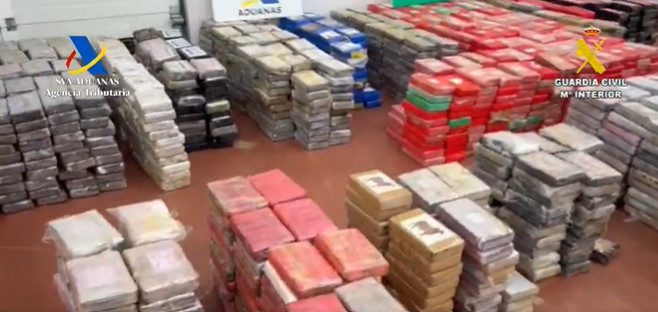
The latest case involves Spanish authorities seizing 2.6 tonnes of cocaine concealed in a shipment of coconuts exported from Ghana’s Port of Tema.
Get more exclusive breaking news updates on our WhatsApp channel .
The drugs were discovered in two shipping containers that arrived at the Port of Valencia on August 22, 2026, having been loaded at Tema Port on August 2. Investigators found the cocaine hidden in false bottoms fitted into wooden crates carrying the coconuts.
Spanish customs officials and the Guardia Civil conducted a controlled delivery operation, tracking the containers to a warehouse in the La Juaida industrial estate in Viator, Almería. Two men were arrested while unloading the cargo. Details of the operation were made public on November 11, 2026.

The Spanish seizure adds to a series of major international interceptions involving commercial shipments originating from Ghana.
In September 2026, French authorities seized nearly 3.9 tonnes of cocaine, valued at approximately €225 million (US$261 million), at the Port of Dunkirk. The drugs were concealed in a container of plastic waste shipped from Ghana.
Investigations into the shipment revealed abnormalities in pre-shipment container scan images at Tema Port. Ghana’s Narcotics Control Commission (NACOC) subsequently arrested three initial suspects, with additional accomplices prosecuted in court.
Another interception occurred on October 31, 2026, at Beirut’s Rafic Hariri International Airport in Lebanon, where approximately 40kg of suspected cocaine was discovered in the luggage of a Syrian national arriving from Accra. NACOC confirmed its cooperation with Lebanese authorities to identify Ghanaian accomplices.
In June 2026, Australian authorities also intercepted 320kg of methamphetamine concealed in a commercial shipment of charcoal exported from Ghana.
The seizures follow several major cocaine interceptions in Europe in 2025. In June that year, Dutch customs officials seized 4.5 tonnes of cocaine concealed in a timber shipment from Tema at the Port of Amsterdam. The seizure was the largest single interception in the port’s history at the time.
In November 2025, Belgian authorities intercepted 2,829kg of cocaine hidden in a shipment of cassava flour from Tema at the Port of Antwerp. A further 1,158kg of suspected cocaine originating from Ghana was seized at the same port in December.
According to figures reported by JoyNews Research in September 2026, Ghana ranked as the fifth-largest country of origin for cocaine seized at the Port of Antwerp in 2025. It was the only African country among the top five.
The classification refers to the country from which shipments were exported, not necessarily where the drugs were produced. Intelligence indicates that much of the cocaine originates from South America before being routed through Ghana and concealed in legitimate commercial exports destined for international markets.
JoyNews Research also tracked 28 narcotics-related cases linked to Ghana between January 2025 and September 2026, including 11 separate cocaine interceptions involving approximately 15.8 tonnes.
Government Orders Review Of Port Security
Following the September 2026 seizure in France, President John Dramani Mahama convened an emergency meeting with security chiefs and directed the establishment of an inter-agency task force to review and repair detection protocols across the country’s seaports, airports and land borders.
The repeated interceptions have raised questions about the effectiveness of Ghana’s port and border security systems, particularly the scanning and inspection procedures at Tema Port.
The developments have also triggered political and public criticism, with opposition figures, including members of the New Patriotic Party (NPP), demanding investigations into the operational integrity of Tema Port.
There have also been public calls for changes in the leadership of security institutions, including NACOC and the Ghana Airports Company Limited (GACL).
A major concern is how multi-tonne shipments of cocaine could pass through Ghana’s export systems despite existing pre-shipment scanning procedures.
The interceptions have intensified scrutiny of Ghana’s port security controls and the measures being taken by authorities to prevent the country’s commercial export channels from being used for international drug trafficking.