A recent political commentary has delivered a forceful defence of former President John Dramani Mahama while sharply criticising the previous New Patriotic Party (NPP) administration and what it describes as a troubling decline in journalistic integrity in Ghana.
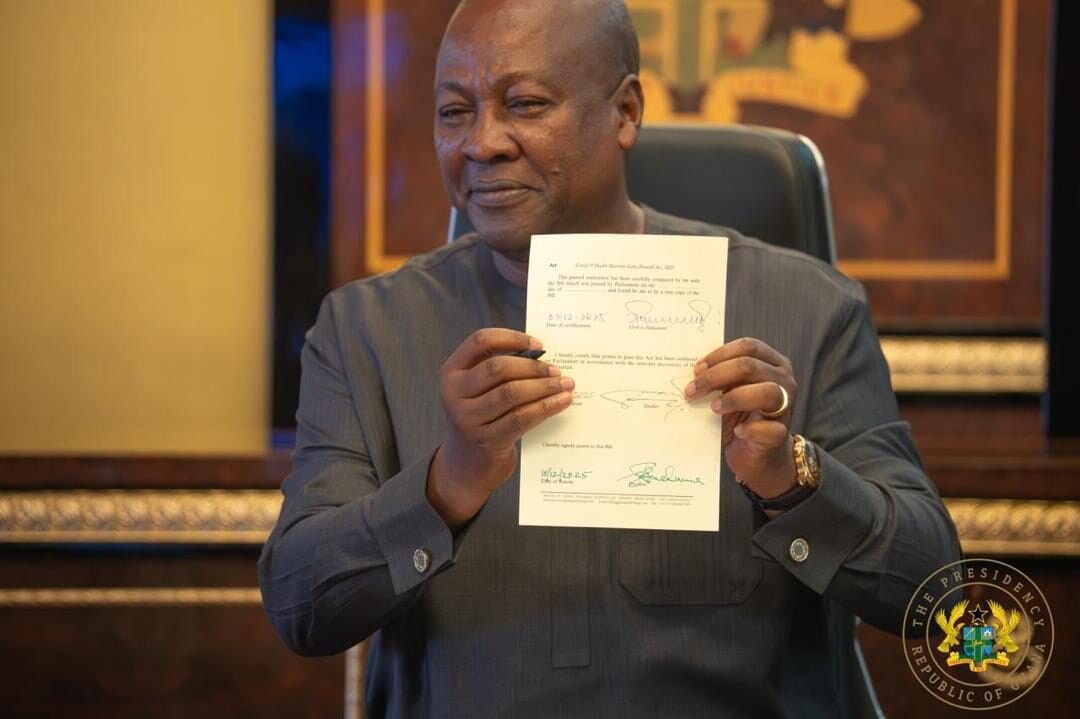
The analysis centres on Mahama’s repeal of the COVID-19 Levy, signed on December 10, 2025, which is presented as proof of a responsive, people-centred government fulfilling its promise to remove the post-pandemic 1% tax.
Get more exclusive breaking news updates on our WhatsApp channel .
The commentator frames this action as emblematic of a leadership style that listens closely to the public and responds decisively.
Mahama is portrayed as a standout figure whose governance, the commentator argues, will have a positive impact for decades.

His return is described as both a correction of past missteps and a national turning point.
The commentary moves further, urging citizens to be ready to defend his administration and Ghana’s democracy “with our blood, with our heart,” insisting that political adversaries, described as “vultures” and “scavengers”,—are waiting for any opportunity to derail the country’s progress.
It insists that the mandate given to Mahama represents the “voice of the people,” and therefore must be protected.
The analysis also delivers a scathing review of the previous NPP government, concentrating on what it characterizes as severe transparency failures.
Central to this criticism is the controversy over the presidential jet, which the NPP allegedly rented at €18,000 per hour without disclosing the condition of the existing Falcon 900.
The Defence Minister’s justification, citing issues such as flight range and long refuelling stops, is dismissed as inadequate and even insulting.
The commentator argues that public outrage stemmed not from the idea of securing a new jet, but from the government’s refusal to provide honest information.
Equally severe is the critique of the National Cathedral project.
The commentary claims the initiative was founded on deceit, noting that although President Akufo-Addo had publicly described it as a personal pledge to God, more than $90 million in public funds was used without citizens’ knowledge.
This, it argues, represents both an abuse of religion and a misuse of taxpayer money.
Beyond politics, the commentary turns its attention to Ghanaian journalism, accusing parts of the media of speculation, misinformation and the abandonment of professional rigour.
A female broadcaster on Adom FM is singled out for discussing alleged “underground recruitment of teachers” without verifying the claim with the Ministry of Education or the Ghana Education Service. This incident is presented as symptomatic of a wider erosion of standards.
The commentator contrasts current conduct with the integrity of veteran journalists from earlier eras, lamenting what he calls the rise of “clowns” in the media space.
The document ultimately ties together three core themes: praise for Mahama’s decisive tax repeal, condemnation of the previous government’s alleged opacity, and concern over the declining quality of journalistic commentary in Ghana.