
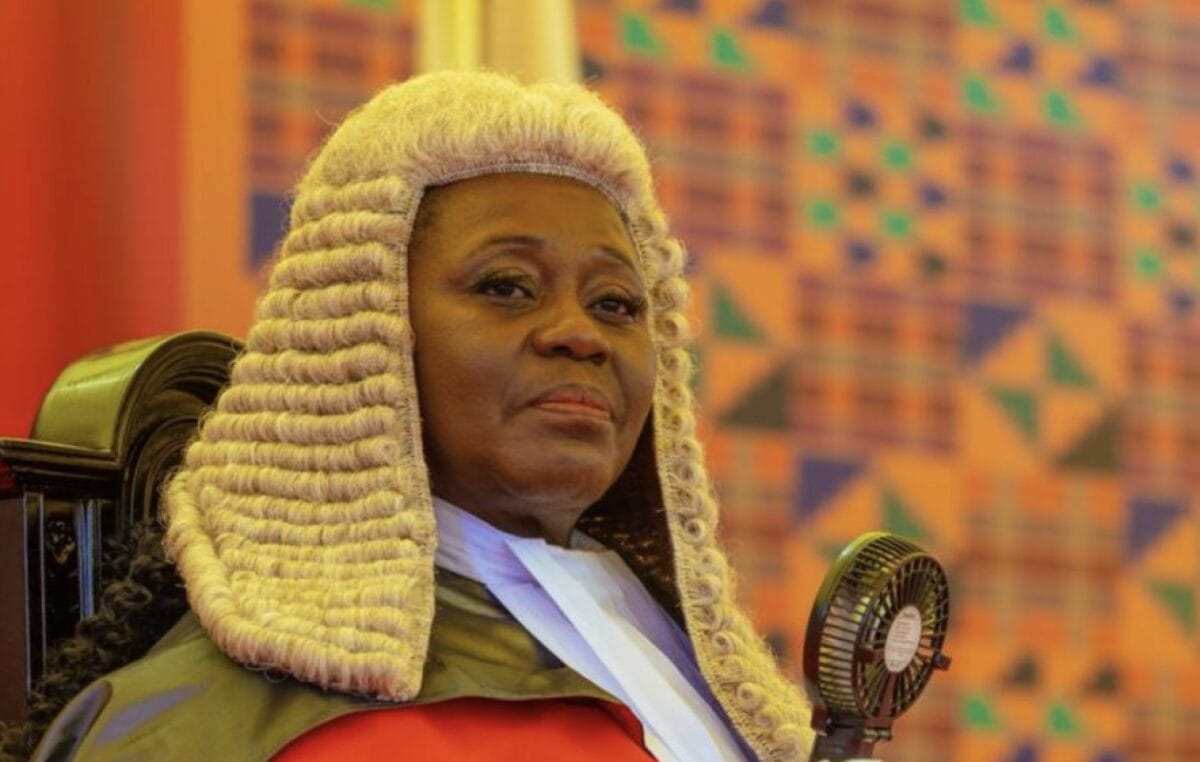
By our Constitutional architecture, the Chief Justice of the Republic of Ghana sits in a composite capacity as both a justice of the Superior Court as well as the administrative arrowhead of the Judiciary.
In other words, you cannot become a Chief Justice without first being a Justice of the Superior Courts. The office name speaks for itself: Chief Justice (Chief of all the justices).
Get more exclusive breaking news updates on our WhatsApp channel .
When one is appointed as a Chief Justice of the Republic of Ghana, s/he is not merely the admin head of the Judiciary in pursuance of Article 125(4) of the Constitution, but s/he is also a Juristic officer of the Superior Courts per Article 128(1) of the Constitution.
The trespasses that are capable of constituting a basis of a petition for the removal of the “Chief judge” as envisaged in Art 146(4) of the Constitution inexorably lead to a removal, when proven, of the CJ qua CJ.

Such an exercise, therefore, is not one of demotion but excision. That is, the CJ is removed from that composite position as both a justice of the Superior Court and as admin head of the Judiciary because the proven grounds for dismissal (stated misbehaviour, incompetence, infirmity of mind) also go to the propriety to serve as a Superior Court Justice as well. It is not decoupled.
See the Code of Conduct for Judges & Magistrates in Ghana (It is a judicial Bible containing all the forbidden transgressions of all Judges in Ghana). A breach of a single Code by a judge will result in his judicial doom.
Nearly 30 years ago, some hypocritical leaders of the Ghana Bar Association actually went to Court to get the then-sitting Chief Justice removed from office. The Supreme Court was confronted with similar debates now making the rounds.
So in what became known as Ghana Bar Association vrs Attorney General [1995-6] GLR, the Supreme Court speaking through Ghana’s judicial lion-heart, FY Kpegah JSC, (as he then was) distilled the law as follows:
“Without mincing words, the ultimate result this action is intended to achieve for the Plaintiff (Ghana Bar Association) is the removal of the Second Defendant as Chief Justice of Ghana, and, as a fallout, a Judge of the Supreme Court. The substratum of the Plaintiff’s case, as we have stated earlier, is that the Second Defendant is not a man ‘of high moral character and proven integrity’ to be the Chief Justice; ipso facto, a judge of the Supreme Court, since the qualifications are admittedly the same. For if the Second Defendant is disqualified from occupying the post of Chief Justice on grounds of lack of integrity, I do not see how he can continue to be a judge of the Supreme Court.”
Where a law sets out a procedure for how a thing is to be done, it is only that procedure that must be followed. See Boyefio vrs NTHC.
Let me rest here by invoking the morbid gladiatorial salutation directed at the Court thus: “ave, Imperator, morituri te salutan”, to wit: this case that’s likely about to fail, salutes you.