

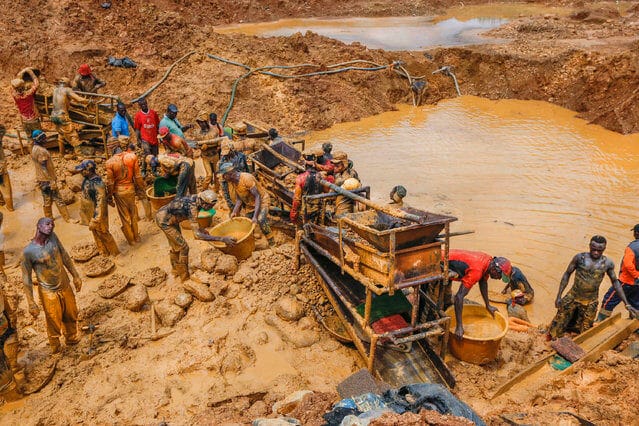
Accra, Oct. 8. Illegal small-scale mining, known locally as galamsey, has morphed from a survival tactic into a sprawling, well-financed criminal enterprise that is ravaging Ghana’s environment and threatening national stability.
Once-clear rivers now flow thick with mercury and cyanide, while lush forests have been reduced to barren scars on the landscape. Despite years of military interventions and public outrage, the menace persists, buoyed by sophisticated networks, political cover, and cross-border financing.
Get more exclusive breaking news updates on our WhatsApp channel .
Experts warn that Ghana cannot win this fight using outdated enforcement tools. What is needed, they argue, is a hybrid strategy rooted in Intelligence-Led Policing (ILP) and Community-Oriented Policing (COP), a coordinated approach that blends data-driven enforcement with community partnership.
Intelligence-Led Policing: Targeting the machinery behind galamsey
ILP represents a proactive, intelligence-driven framework designed to expose and dismantle organised criminal operations. Applied to galamsey, it involves mapping illegal mining hotspots using satellite and drone surveillance, monitoring river tributaries contaminated by mining effluents, and tracking the movement of excavators, chemicals, and illicit gold.

Unlike ad-hoc raids, ILP enables law enforcement to uncover the financiers, suppliers, and political figures who sustain the illegal trade. By following data rather than dirt trails, authorities can choke the network from its core, making illegal mining a high-risk, low-reward enterprise.
Community-Oriented Policing: Restoring trust and local stewardship
While ILP disrupts the supply chain, COP reclaims trust and territory. It embeds security efforts within local communities, engaging traditional leaders, youth groups, and civil society in environmental protection. COP fosters safe reporting channels for illegal mining activities and promotes education on the health and ecological dangers of galamsey.
Many mining communities face a painful dilemma: economic dependence on galamsey amid its devastating social and environmental costs. COP seeks to transform such complicity into stewardship, empowering residents as guardians of the nation’s land and water resources.
A breakthrough from academia
A groundbreaking academic intervention by Mr. Ernest Kwaku Agyei, a Lecturer at Kumasi Technical University, offers a transformative framework. His PhD research at Sir Padampat Singhania University in India integrates geospatial intelligence, behavioural mapping, and predictive analytics to create a hybrid ILP–COP model tailored to the galamsey crisis.
Mr. Agyei’s system envisions a real-time intelligence-sharing loop between law enforcement and communities, ensuring that data gathered from the field informs swift, targeted action. His research demonstrates how science can shape policy to dismantle illegal mining networks sustainably.
A national imperative
Ghana stands at a crossroads. The ecological and economic costs of galamsey continue to rise, even as rivers turn toxic and farmland erodes. Experts insist that symbolic crackdowns must yield to science-led, community-driven strategies if Ghana hopes to reverse the damage.
Before launching expensive remediation projects to clean poisoned rivers, the underlying source of contamination, galamsey machinery, must be dismantled. Without enforcing ILP and COP, any restoration effort would be futile, like pouring clean water into a leaking vessel.