The Municipal Chief Executive for Ketu North, Reverend Martin Amenaki, has underscored the need for Ghana to drastically reduce its annual food import bill of more than US$2 billion, warning that continued dependence on imported rice, poultry and processed foods is undermining the nation’s agricultural foundation.
Speaking at the 41st National Farmers’ Day celebration held at the Dekpor M/A Basic School, he cautioned that the growing preference for imported foods, often seen as more prestigious, was reducing demand for high-quality local produce.
Get more exclusive breaking news updates on our WhatsApp channel .
He said the trend discouraged investment, depressed farm-gate prices and weakened the agricultural economy.
Rev Amenaki called for renewed commitment under the theme, “Feed Ghana, Eat Ghana, Secure the Future,” noting that consumer patriotism and supportive policies were needed to guarantee sustainable markets for farmers.

He outlined several government interventions aimed at strengthening food systems, including the Feed Ghana and Feed the Industry initiatives, improved local procurement under the School Feeding Programme, institutional farming in senior high schools, rehabilitation of the Weta Irrigation Scheme, expanded mechanisation services, Farmers’ Service Centres, enhanced rice-milling facilities and the ongoing Nkoko Nketenkete poultry value-chain project.
He urged individuals, institutions and businesses to partner with the Assembly to build a resilient agricultural economy, describing farmers as “the backbone of the municipality whose hard work continues to sustain livelihoods.”
Municipal Director of Agriculture, Mr Believer Avenorkadzi, praised farmers for their resilience despite erratic rainfall, high input prices and logistical constraints.
Reflecting on the national theme, he said: “Eat Ghana” encourages appreciation of local foods, “Feed Ghana” calls for increased production and quality, and “Secure the Future” emphasises building a technology-driven, resilient food system.
He noted that Ketu North continues to play a key role in national food production with staples such as cassava, rice, maize, vegetables and legumes supporting thousands of households.
Livestock and poultry production also remain vital for youth employment and agro-processing.
Mr Avenorkadzi outlined interventions undertaken by the Department of Agriculture, including extension services, regular field visits and training on good agronomic practices, fertiliser use, pest management and post-harvest handling.
The district also distributed 1,400 bags of fertiliser, more than 1,000 improved rice seeds, improved cassava cuttings and agrochemicals. Partnerships with the West Africa Food System Resilience Programme (FSRP), FILMA and Hopeline Institute have strengthened agribusiness skills, financial inclusion and safe chemical use.
Under the Feed Ghana Programme, 195 Farmer-Based Organisations were validated and 4,451 farmers digitally registered to improve planning and transparency.
Despite these gains, key challenges persist, including inadequate extension personnel, limited storage and processing facilities, insufficient mechanisation, flooding in parts of the Weta Irrigation Scheme and rising input costs.
He called for expanded irrigation, improved post-harvest systems, more youth involvement in mechanised farming and stronger promotion of local food consumption.
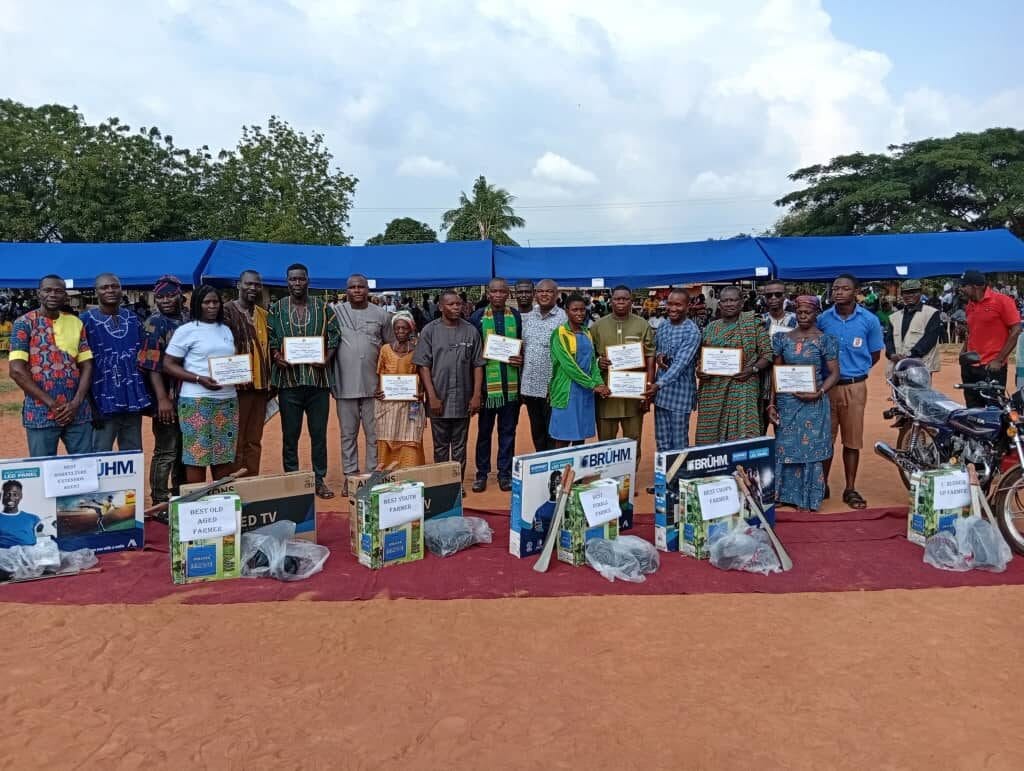
The celebration ended with awards to outstanding farmers. Mr Wonder Pomevor was named Overall Best Farmer, receiving a tricycle and cutlasses, while other awardees received a motorbike, television set, wheelbarrows, Wellington boots and a knapsack sprayer.