
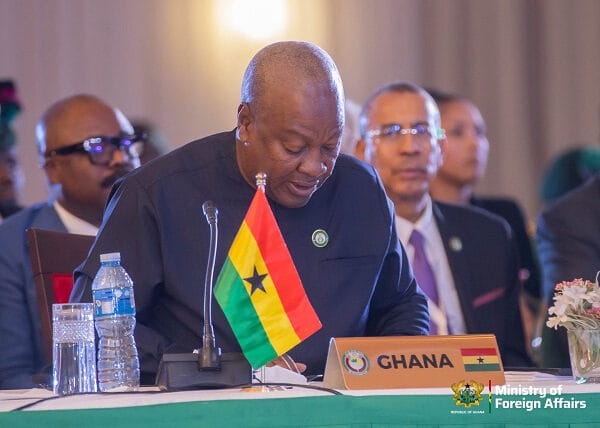
The Economic Community of West African States (ECOWAS) has unanimously endorsed His Excellency John Mahama as West Africa‘s sole candidate for the rotating Chairmanship of the African Union (AU) in 2027, following a decision by the Authority of Heads of State and Government at its 68th Ordinary Summit in Abuja, Nigeria.
The endorsement reflects regional confidence in Mahama’s extensive experience in international diplomacy and high-level engagement, with leaders expressing full confidence in his capacity to represent the sub-region at the continental level.
Get more exclusive breaking news updates on our WhatsApp channel .
The AU Chairmanship, which rotates among Africa‘s sub-regions, will fall to West Africa in 2027.
The Chairperson presides over AU Assembly meetings, provides political leadership for the continent, represents Africa in major international engagements, and plays a central role in advancing peace, security, integration, and development agendas.

Meanwhile, Ghana’s political and legal landscape is witnessing heightened debate over the future of the Office of the Special Prosecutor (OSP).
A private members’ motion in Parliament seeks to repeal the OSP Act, arguing that the office has failed to deliver value for money, lacks nationwide presence, and has exceeded its authority.
Proponents cite over GHS 1 billion spent since inception, with a 2024 allocation of about GHS 250 million comparable to the entire Attorney General and Ministry of Justice budget, contending that resources would be better utilised through a special division within the Attorney General’s office to expand district-level reach and case throughput.
Critics also point to the OSP’s continued concentration in Accra, an absence of tangible prosecutorial outcomes, and alleged operational excesses.
The motion’s sponsors have, however, paused their effort following John Mahama’s public view that abolition would be premature, interpreting his intervention as a call for improved performance rather than dismantling the institution.
Defenders of the OSP argue the repeal push is premature and misguided.
They note the office’s nascent status, established by law in 2017, with effective operations only stabilising after regulatory approvals, relocation, and permanent staffing concluded around 2023–2024.
The OSP is framed as a critical, independent anti-corruption body designed to fill a gap left by the politically appointed Attorney General, with a statutory mandate to operate free from direction and pursue cases involving politically exposed persons.
Supporters further caution that other state institutions have faced setbacks without calls for dissolution, urging stakeholders to strengthen the OSP’s independence and capacity rather than dismantle it.