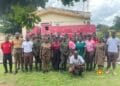
A man identified as Abu Trica was arrested in Swedru, Ghana, reportedly just one hour after his arrival, ending what sources describe as a three-month multinational search that involved the FBI and a wide network of Ghanaian security institutions.
The development, acknowledged by the U.S. Attorney’s Office for the Northern District of Ohio, is being framed as one of the most coordinated cross-border crime operations involving the two countries in recent years.
Get more exclusive breaking news updates on our WhatsApp channel .
The narrative provided indicates that U.S. agencies, including the DEA Sensitive Investigation Unit, Department of Homeland Security, Department of Justice, DOJ’s Office of International Affairs, and the FBI Legal Attaché Office in Accra, worked closely with Ghana’s Attorney General’s Office, EOCO, Ghana Police Service, Cyber Security Authority, NAPOK, Narcotics Control Commission, and the National Intelligence Bureau.
Commentators argue such operations would not have been possible without deep Ghanaian involvement, suggesting the arrest underscores an often-unseen level of cooperation between the two nations.

Though the specific charges remain undisclosed, the surrounding claims heavily point toward high-value financial or cybercrime. One allegation describes an astonishing $8 million being acquired in just five hours, while another suggests that three informants received free U.S. visas as rewards, hinting at substantial behind-the-scenes intelligence work.
Public commentary has also emerged. An individual known as Showboy expressed satisfaction with the arrest, predicting that Abu Trica would lose all assets and be forced to “start life again.”
His remarks reflect a broader frustration at how individuals involved in fast-money schemes create social pressure for ordinary citizens. The critique points to a culture where illicit wealth distorts expectations, including the belief that a person in their 30s must have 100,000 Ghana cedis in savings to be considered successful.
The incident has revived discussion about the strength of Ghanaian state institutions. While sometimes perceived as slow or ineffective, the operation is cited as proof that agencies can act swiftly and decisively when motivated.
“If they really want to arrest you, it will be simple. Very easy,” the narrator noted, pointing to the speed with which the joint task force moved once Abu Trica resurfaced in Swedru.
A call for reciprocity also surfaced from the source, suggesting that after Ghana’s extensive support to U.S. authorities, the United States should likewise assist in returning wanted individuals to Ghana.
The arrest, the multinational effort behind it, and the public reflections that followed have collectively illuminated not only the scale of modern transnational crime but also the social consequences of unearned wealth and the expectations placed on law enforcement in Ghana’s evolving security landscape.