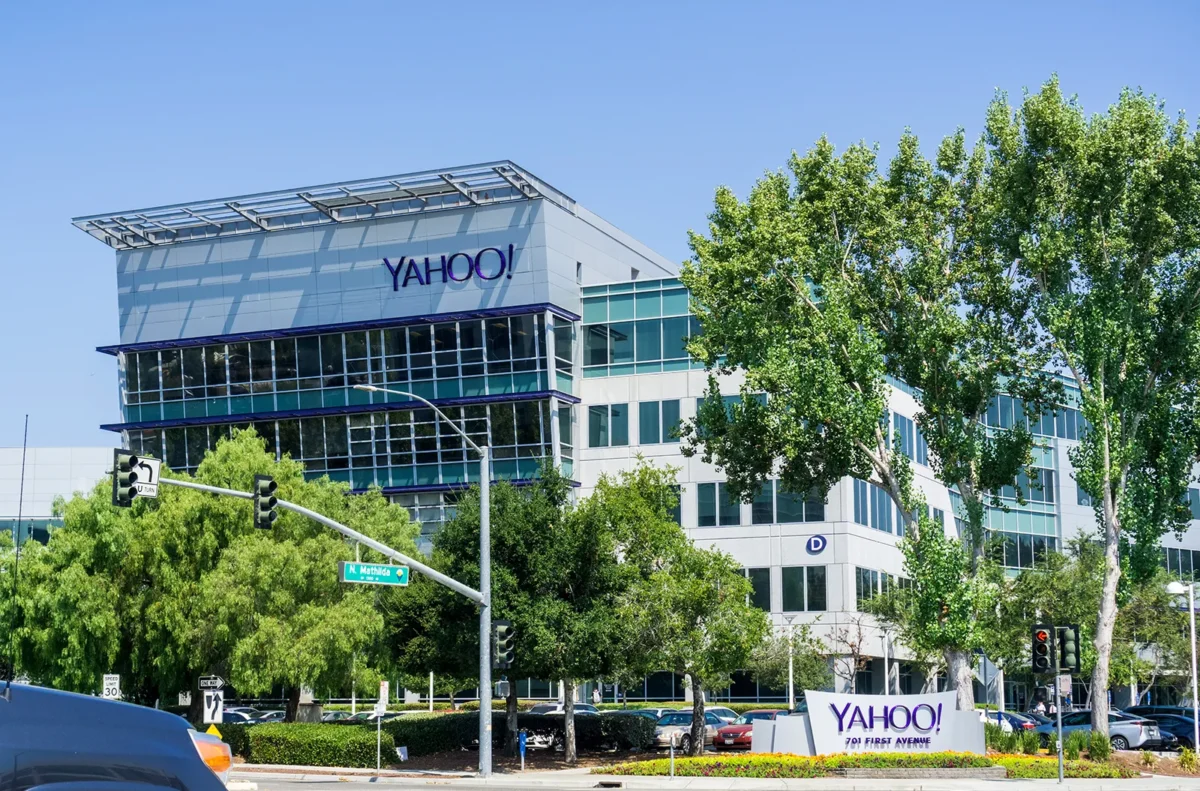
Yahoo, once one of Silicon Valley’s most valuable companies, saw its valuation collapse from $125 billion at its peak in 2000 to just $4.5 billion when it was sold to Verizon in 2017, marking one of the largest destructions of shareholder value in tech history.
Founded in 1994 by Stanford students Jerry Yang and David Filo as a simple directory of websites, Yahoo quickly gained traction, reaching over one million monthly users within a year. After securing backing from Sequoia Capital and a major investment from SoftBank, the company went public in 1996 with fewer than 50 employees. Its stock surged on debut, valuing the company at nearly $850 million.
Get more exclusive breaking news updates on our WhatsApp channel .
During the late 1990s, Yahoo became the dominant “front door to the internet,” offering services such as Yahoo Mail, Yahoo Finance, and GeoCities. Its business model relied heavily on display advertising, generating $588 million in revenue by 1999.
However, the company struggled with a persistent identity crisis, positioning itself as a media company while the market viewed it as a technology leader. This misalignment influenced a series of critical strategic decisions.

In 2002, Yahoo declined to acquire Google after negotiations rose from $1 billion to $3 billion. At the time, Yahoo itself was valued at around $5 billion. Google would later grow into a company worth over $2 trillion.
In 2006, Yahoo failed to acquire Facebook after offering $850 million, short of the $1 billion sought by Mark Zuckerberg. Facebook would eventually go public at a $104 billion valuation.
In 2008, Yahoo rejected a $47.5 billion acquisition offer from Microsoft. When the deal collapsed, Yahoo’s stock dropped 15% in a single day, wiping out $6 billion in value and triggering shareholder lawsuits.
Internally, the company faced operational challenges highlighted by the 2006 “Peanut Butter Manifesto,” which criticised Yahoo for spreading resources too thin across multiple initiatives. Between 2000 and 2004, Yahoo outsourced its core search function to Google, effectively strengthening a direct competitor. Revenue peaked at $7.2 billion but declined to $4.5 billion by 2012 as Google and Facebook captured the digital advertising market.
A key financial bright spot came from a 2005 investment in Alibaba, where Yahoo acquired a 40% stake for $1 billion. The investment generated a 3,500% return and became the company’s most valuable asset, often masking the deterioration of its core business.
In 2012, Yahoo appointed Marissa Mayer as CEO in an effort to revive growth. Mayer led an aggressive acquisition strategy, spending $2.3 billion on more than 50 companies, including Tumblr for $1.1 billion. The Tumblr acquisition proved unsuccessful, with $712 million written down, and the platform was later sold for less than $20 million.
The company’s challenges were compounded by major security failures. In 2013, a data breach affected 3 billion user accounts, followed by another breach in 2014 impacting 500 million accounts. These incidents were not disclosed until 2016, during acquisition talks with Verizon.
In 2017, Verizon acquired Yahoo’s core business for $4.5 billion, a figure reduced by $350 million due to the breach disclosures. Key assets, including stakes in Alibaba and Yahoo Japan, were spun off into a separate entity, Altaba. Verizon later sold Yahoo to Apollo Global Management in 2021 for $5 billion.
Despite its decline, Yahoo continues to maintain a significant user base, with approximately 900 million users still accessing services such as Yahoo Mail and Yahoo Finance.