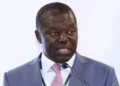
Accra, Oct. 22, GNA. The Minister of Lands and Natural Resources, Mr Emmanuel Armah-Kofi Buah, has held discussions with the Managing Director of Ghana Water Limited (GWL), Mr Adam Mutawakilu, to deepen collaboration between the two institutions aimed at protecting the nation’s water bodies and ensuring sustainable water production.
The meeting, held in Accra on Wednesday, addressed shared challenges affecting the water and natural resources sectors, particularly the destructive impact of illegal mining (galamsey) on rivers and streams that serve as raw water sources for domestic and industrial use.
Get more exclusive breaking news updates on our WhatsApp channel .
Mr Buah reaffirmed the government’s commitment to safeguarding Ghana’s water resources and restoring the natural environment through targeted reforms, strict enforcement, and innovative initiatives such as the “Tree for Life” afforestation project and the “Blue Water Guards” programme.
He explained that the Tree for Life initiative, launched by President John Dramani Mahama in the Ashanti Region, seeks to restore degraded landscapes while creating green jobs for young people.

“We have created what we call the Blue Water Guards, patriotic young Ghanaians who believe it is wrong to destroy our rivers and are acting as first responders and intelligence officers to protect them,” Mr Buah said.
He noted that the Blue Water Guards were already helping to identify and dismantle illegal mining operations along riverbanks, adding that their work was vital in reversing the ongoing environmental devastation.
“You ride along some of these rivers, and you see the devastation,people with machines in the water, poisoning the rivers. But now, the Blue Water Guards are fighting back. They are our defenders of the nation’s water,” he emphasized.
The Minister announced major reforms within the mining sector to address the root causes of illegal mining and its environmental consequences. A national review of small-scale mining licenses has led to the revocation of more than 300 licenses due to irregularities, he revealed.
“We are overhauling the Minerals and Mining Act, 2006 (Act 703). By next year, we expect to have a new law that ensures transparency and community participation in the licensing process. No one should sit in Accra and issue a mining license for an area they’ve never visited,” Mr Buah added.
He also disclosed that the Ministry was deploying tracking devices and geo-fencing systems for excavators to ensure they operate only within licensed areas, with automatic alerts sent to security forces when machinery encroaches on water bodies.
While acknowledging the economic importance of gold mining, Mr Buah stressed the need for responsible and sustainable mining practices, highlighting the introduction of “Responsible Cooperatives”, groups of trained small-scale miners operating within legal and environmentally sound frameworks.
On his part, Mr Adam Mutawakilu, Managing Director of Ghana Water Ltd, commended the Ministry for its recent interventions, noting visible improvements in water quality at some treatment plants.
“Yes, it’s getting better. For instance, at Kwanyako, we are back to full capacity, and we can feel that through the consistency and effort you have put in. In the near future, the water bodies will recover, and Ghana Water will be able to supply safe water to all,” he said.
However, Mr Mutawakilu cautioned that siltation and salinity at raw water intakes remained major operational challenges.
“Some of our intakes have become heavily silted, and we use submersible pumps that are deep down. The clean water sits at the surface, but the pumps can’t reach it. We have to re-engineer and lift them closer to the surface to treat clean water,” he explained.
He warned that if siltation at intakes was not urgently tackled, it could lead to serious water shortages during the dry season.
Mr Mutawakilu reaffirmed GWL’s readiness to collaborate with the Ministry on desilting major water sources, enforcing mining regulations, and educating communities about the importance of protecting the nation’s water bodies.