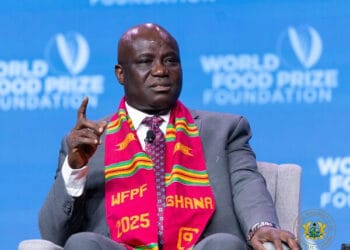


Mr Eric Opoku, Minister of Food and Agriculture, has announced that government will procure more than 4,000 agricultural machines and implements to equip the first 50 Farmers‘ Service Centres (FSCs) under the Feed Ghana Programme, marking a major nationwide push to modernise and mechanise agriculture.
Speaking at the Government Accountability Series in Accra on Monday, the Minister said the procurement package includes over 660 tractors, 400 combine harvesters and a range of complementary equipment.
Get more exclusive breaking news updates on our WhatsApp channel .
He stressed that the FSCs are designed to benefit smallholder farmers who continue to face limited access to mechanisation services.
According to Mr Opoku, the centres will offer land preparation, input supply, harvesting support, storage facilities, extension advisory services, market linkage and affordable equipment leasing.

He said modernisation goes beyond machines and requires a stronger frontline extension workforce.
Expressing concern over Ghana’s current Agricultural Extension Agent (AEA) ratio of 1:1,500,far below the international standard of 1:500,the Minister disclosed that the Ministry is procuring 540 motorbikes to enhance extension mobility, with 150 already distributed.
Additionally, 400 AEAs are being recruited as Feed Ghana Coordinators across all districts, with logistics underway for deployment.
To strengthen long-term extension delivery, Mr Opoku announced that 10,000 youth are being engaged under a four-year National Service programme, with qualified personnel expected to be retained annually as permanent staff.
The initiative also targets clearing the backlog of graduates from agricultural and veterinary colleges dating back to 2015.
He highlighted the rapid nationwide expansion of Community Commodity-Focused Farmer Cooperatives, describing them as vital structures for coordination and inclusivity in the agricultural sector. As of October 11, 2025, more than 70,000 cooperatives had been established.
Mr Opoku said the cooperatives are being positioned as hubs for training, financing, mechanisation access, climate advisory services and market coordination.
He added that the model will improve farmers’ bargaining power, enhance economies of scale and promote collective problem-solving.
“These cooperatives are being integrated into every major intervention, from mechanisation, to weather advisory, ensuring no farmer is left behind,” he said.
“This is to give the farmers a voice in all agricultural matters. Once they are into cooperatives, they can negotiate for reasonable prices for inputs and reasonable prices for their outputs.”