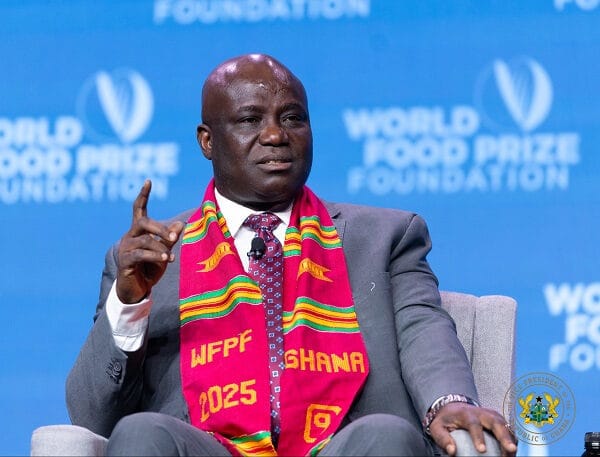
Mr Eric Opoku, Minister of Food and Agriculture, has unveiled a broad set of reforms under the Agriculture for Economic Transformation Agenda (AETA), describing them as a blueprint for rebuilding Ghana’s agricultural sector and positioning it as a pillar of economic growth.
Speaking at the Government Accountability Series in Accra, he said the initiatives are designed to restore food security, expand agro-industrialisation and strengthen the resilience of the national food system.
Get more exclusive breaking news updates on our WhatsApp channel .
He explained that the Ministry has prioritised seed sovereignty, fertiliser quality control, modern soil management systems, climate intelligence tools, irrigation expansion, mechanisation and the strengthening of farmer cooperatives.
“We are rebuilding the food system from the ground up with resilience, sustainability and equity at the centre,” he said.

A key shift will begin in 2026, when only locally produced seeds will be supplied to farmers. Mr Opoku said this change is intended to eliminate delays commonly associated with imported seeds.
He highlighted new investments in seed testing equipment, soil laboratories and nationwide soil sampling to guide fertiliser blending and determine crop suitability across regions.
On irrigation, he reported the construction of 10 new dams, rehabilitation of eight existing dams and the installation of 250 solar-powered boreholes.
Major irrigation schemes, including Vea, Weta, Tanoso, Ashaiman, Kpong and Aveyime, are also undergoing refurbishment to support year-round farming.
Mechanisation, he noted, is being boosted through Farmers’ Service Centres, with more than 4,000 units of machinery such as tractors and combined harvesters procured for farmers nationwide.
To strengthen farmer organisations and improve market access, the Ministry has established 70,000 community commodity-focused cooperatives.
Mr Opoku said that in the coming years, government will intensify investments in irrigation and mechanisation, enhance agricultural research, expand agro-industrial partnerships, roll out climate-smart technologies and digitise agricultural systems to support efficient production.
“Agriculture must no longer be seen as a way of life, but as a business that will drive employment, industrialisation and food sovereignty,” he emphasised.