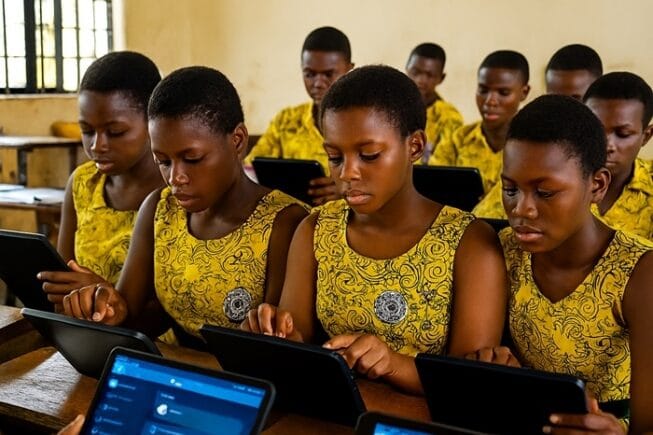
On a bright Tuesday morning in a senior high school outside Takoradi, a teacher taps through an app during a Professional Learning Community (PLC) session and generates a complete lesson plan within minutes.
Her quiet smile of relief reflects a broader shift taking place across Ghana’s education system, a distinctly African-led, culturally anchored strategy for embedding artificial intelligence into teaching and learning.
Get more exclusive breaking news updates on our WhatsApp channel .
From Accra to the northern regions, teachers are gaining confidence as they adopt AI tools designed specifically for Ghanaian classrooms.
This movement is rooted in national ownership, respect for local values and a deliberate approach to responsible innovation.

The transformation follows the Ministry of Education’s introduction of a new Senior High School curriculum in October 2024, which moves beyond memorisation and prioritises competencies, character formation and Ghanaian identity.
The vision is bold, the first of its kind to explicitly centre national pride and civic responsibility, but it comes with an enormous implementation task: retraining 68,000 teachers to deliver the programme to 1.4 million learners.
To meet this challenge, the Ministry relies on a strategy blending local leadership with global support.
NaCCA and CENDLOS lead development efforts alongside Playlab.ai, T-TEL and the Mastercard Foundation, with subsidised support from AWS and Anthropic, lowering usage costs so teachers can access the apps for free.
The principle guiding the entire ecosystem is clear: AI should elevate teacher expertise, not replace it.
Every subject-specific app is built by Ghanaian curriculum experts who embed national values, cultural references and the philosophy of the new curriculum.
The AI models are trained on locally developed teacher guides, learner materials and gender equality frameworks, making them responsive to real classroom contexts. This represents a continental milestone, an African education system driving its own AI transformation rather than importing generic tools.
To reassure educators, the Ministry requires all apps to undergo a rigorous four-stage quality assurance process. Technical accuracy is tested until the app consistently reaches at least 80 per cent correctness across 20 straight assessments.
Curriculum writers then review the educational value. Teachers in pilot schools evaluate usability, followed by regional testing to confirm infrastructure readiness.
This structured approach has helped overcome scepticism among teachers, often wary of new technology.
Ghana’s integration model is equally innovative. Since May 2023, all 712 senior high schools have held weekly 90-minute PLC sessions, attended by roughly 84 per cent of teachers.
These sessions now double as AI training hubs, allowing teachers to test the apps, share feedback and refine instructional practice inside a system they already trust.
QR codes printed in PLC handbooks link directly to curriculum materials and app resources, making adoption seamless rather than disruptive.
Teacher experiences during early development reinforce the momentum. In July 2025, 29 NaCCA staff were trained to build subject-specific tools, which were then piloted by 71 teachers across more than 30 subjects.
Their feedback was overwhelmingly positive: 95 per cent reported faster lesson planning, 99 per cent found no errors in generated content, and 93 per cent said they intended to keep using the apps beyond PLC sessions.
As Ghana prepares for a nationwide rollout in October 2025, countries including Sierra Leone, Kenya and Rwanda have shown interest in adopting the model.
They view Ghana’s system as scalable, culturally aligned, cost-efficient and sustainable, with strong feedback loops and content management systems that ensure continuous improvement.
Looking forward, acting NaCCA Director General Professor Samuel Ofori Bekoe says the Ministry and its agencies are working with initiatives such as L4H and Code Raccoon to expand development of teaching and learning apps.
He encourages EdTech organisations to contact NaCCA for guidelines and approvals to ensure that new tools meet national standards.
Ghana’s experience illustrates how innovation becomes empowering when rooted in local leadership, cultural grounding and ethical stewardship.