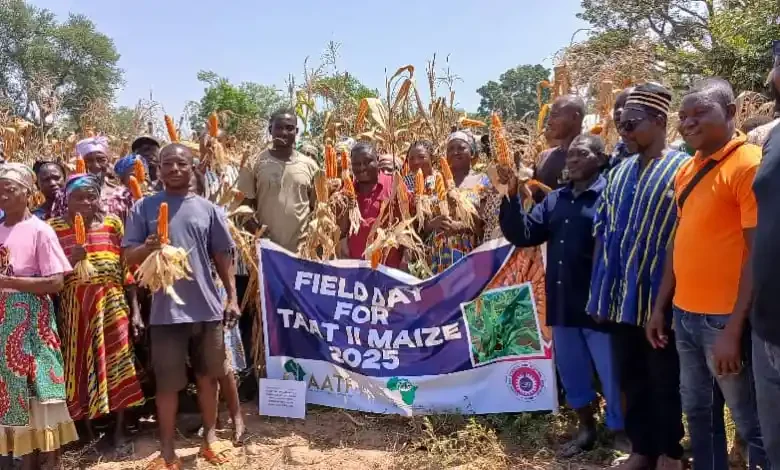
The Council for Scientific and Industrial Research Savanna Agricultural Research Institute (CSIR SARI), in partnership with the Ministry of Food and Agriculture (MoFA), has unveiled four newly developed maize varieties aimed at enhancing productivity, nutrition, and income for smallholder farmers in Ghana.
The varieties are CSIR Dimaali Engee and CRI Abebe (both Pro-Vitamin A maize), CSIR Adubi Boyo (a Quality Protein Maize hybrid), and CSIR Denbea, a high-yielding hybrid tolerant to environmental stresses. They were showcased during a farmers’ field day held at Tolon in the Northern Region.
Get more exclusive breaking news updates on our WhatsApp channel .
The event, led by Dr Isaac Kodzo Amegbor, a maize breeder at CSIR SARI, brought together farmers from Tolon and neighbouring communities, alongside agro-input dealers, seed producers, and agricultural stakeholders.
Dr Amegbor explained that the field day formed part of the Technologies for African Agricultural Transformation (TAAT) programme, designed to promote the adoption of proven, high-impact agricultural technologies capable of transforming smallholder farming systems across Africa.

He said the new maize hybrids were developed after years of intensive breeding and testing to address persistent challenges such as low yields, drought stress, soil infertility, and malnutrition. The initiative is funded by the African Agricultural Technology Foundation (AATF) under the TAAT II Maize Compact.
“Our mission as researchers is to ensure that farmers have access to improved, high-yielding, and nutritious maize varieties that perform well under local conditions,” Dr Amegbor stated. “When farmers are satisfied with their harvests or our technologies, it gives us joy and motivates us to keep developing technologies that work for them.”
He announced that CSIR SARI, in collaboration with AATF, would soon roll out free training programmes for farmers and seed producers to build their capacity in quality seed production and management.
Madam Victoria Basim, an Agricultural Extension Agent in the Tolon District, praised the collaboration between CSIR SARI and MoFA, describing the introduction of nutrient-rich and high-yield maize varieties as a critical step toward improving food security, nutrition, and rural livelihoods.
“We are happy to see our farmers embracing these new varieties. With the right agronomic practices, they can boost their yields and improve the nutritional value of their harvests,” she said.
Mr Iddrisu Muniru Mustapha, Crops Officer at the Tolon District Department of Agriculture, also commended the partners for their contribution to sustainable agricultural transformation in the Northern Region.
The demonstration plot, managed by Mr Ziblim Adam, a lead farmer from Tolon, provided a practical learning platform for participants. Expressing his satisfaction, he said, “I have seen a big difference with these varieties. The plants are more vigorous, the cobs are larger, and the yield looks very encouraging. I plan to host the demonstration again next season.”
Another farmer, Madam Zelia Mohammed, highlighted the nutritional value of the Pro-Vitamin A maize, saying, “As mothers, we are pleased to see maize that is not only high-yielding but also beneficial for our children’s health. I will definitely try the Dimaali Engee variety on my farm next year.”
The field day also featured hands-on sessions on best agronomic practices, focusing on optimal spacing, population density, crop management, and post-harvest handling.
The initiative forms part of CSIR SARI’s broader mission to advance climate-smart, farmer-centred, and nutrition-sensitive agriculture to strengthen food and nutrition security across Ghana.