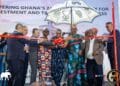
Ghana’s much-discussed “24-Hour Economy” policy, launched to shift the country from raw commodity dependence to value addition and job creation, has come under critical review by economic experts who praise its intentions but question its originality, costing, and implementation framework.
In a detailed discussion involving economist Professor Godfred Bokpin and Dr Theo Achampong, the policy was acknowledged for diagnosing Ghana’s long-standing economic “deformity”, a colonial legacy of exporting unprocessed commodities that still accounts for over 80% of Ghana’s export earnings. While welcoming the initiative’s ambition to create 1.7 million jobs and tackle jobless growth, both experts stressed that “good intentions are not achievements.”
Get more exclusive breaking news updates on our WhatsApp channel .
Prof. Bokpin argued that much of the content echoes previous initiatives such as Ghana Beyond Aid and the Coordinated Programme for Economic and Social Development, stating, “There’s really not much new. The diagnosis is the same, and we’ve seen similar documents before.”
Concerns were raised over the policy’s estimated $4 billion cost, which experts say falls short of the scale needed. “If you’re really conceptualizing a full-scale 24-hour economy, you’ll need more than $4 billion,” said Bokpin, suggesting the figure was grossly underestimated.

A major critique was the government’s tendency to create new authorities and secretariats rather than leveraging existing civil service and local government structures. “Each time a new flagship programme is introduced, we detach it from current systems, increasing bureaucracy and killing ownership,” Bokpin noted. He cited the example of the National Health Insurance Authority, where nearly half of the budget goes to administrative expenses.
Instead, he recommended a “low-cost approach” rooted in decentralization and a mindset shift within existing institutions. The Ghana Police Service, he said, should adopt the 24-hour model as a shift in attitude, not by creating new units.
Policy continuity emerged as a central theme. The experts pointed to the IMF-supported programme in Ghana, which relies on existing state structures like the Ministry of Finance and Bank of Ghana but enforces strict accountability through KPIs, regular reporting, and public transparency. “We’re accountable under the IMF program because we know there will be reviews. That rigour is missing here,” Bokpin said.
For the 24-Hour Economy to work, they recommend embedding performance-based incentives for public officials, integrating data from the Ghana Statistical Service, and establishing six-monthly progress reviews to sustain momentum. They warned that without these mechanisms, the policy risks being forgotten, like many ambitious frameworks before it.
Another challenge is political credit. “Politicians in Ghana don’t like to share credit,” Bokpin observed, cautioning against the rebranding of existing initiatives, such as linking “Grow 24” to “Planting for Food and Jobs”, instead of building on them collaboratively.
With a significant chunk of financing expected to come from non-governmental sources, maintaining investor confidence will depend on consistency and transparency. Drawing from IMF practices, the experts called for clearly defined reporting timelines and a successor framework post-2026 to ensure continuity.