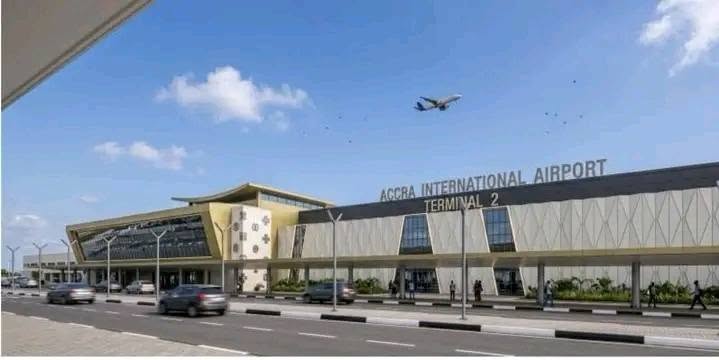
A return airfare from Accra to Kumasi has reportedly reached ₵5,000. The average monthly salary is estimated at around ₵2,580, with many workers earning considerably less.
Think about that. A return flight between the two largest cities can cost almost two months of the stated average salary.
Get more exclusive breaking news updates on our WhatsApp channel .
Yaanom will say if you earn ₵2,580 a month, perhaps you are not supposed to fly.
Fair enough. Air travel is not a right, and not every good or service must be affordable to the average worker.

But then we must ask the next question: what affordable and convenient alternative have we provided?
Accra to Kumasi by road can take five or six hours. We have no fast intercity alternative service connecting the two cities. So we have managed to make the fast option prohibitively expensive for the ordinary worker without building a reasonably fast and affordable alternative.
The unaffordable airfare, with no affordable alternatives, illustrates a much larger problem with the structure of our economy.
Home prices in parts of Accra increasingly resemble those in much richer countries. Kumasi is learning that lesson.
Rents bear little relationship to what ordinary workers earn. Hotel rates can rival those in London, Dubai or New York. Restaurant prices often seem designed for people earning dollars, pounds or euros. Unreliable electricity, internet, school fees, building materials, and basic services keep climbing.
Yet our incomes have not followed our prices.
We are gradually constructing an economy in which people earn locally but are expected to consume internationally.
Greed is certainly part of the story. In some sectors, sellers charge what they think they can get away with, particularly where competition is weak and consumers have few alternatives.
But there are genuine structural costs too. Businesses operate in an expensive environment. Financing is costly. Electricity is expensive. Imported equipment, spare parts and other inputs create exchange-rate exposure. Taxes, levies, regulatory costs, transport costs and financing costs eventually find their way into the price paid by the consumer.
Then there is another, more troubling part of the story.
Not everyone participating in our markets earns money the same way.
There are people whose purchasing power bears little relationship to ordinary salaries, productivity or the value they create. They have access to quick money from the public exchequer through inflated contracts, procurement abuse, political patronage, rent seeking and other forms of extraction.
That money does not remain under mattresses. It enters the same housing, land, hotel, restaurant, vehicle and service markets in which ordinary workers must participate.
A person spending easily acquired public money does not bargain like a teacher, nurse, lecturer, accountant or small business owner spending painstakingly earned income.
He can park his loot in homes. He can pay ₵20,000 for something worth ₵10,000. Once enough people can do that, ₵20,000 starts becoming the market price for everybody.
This raises an uncomfortable possibility. Corruption and rent extraction do not merely deprive the State of money. They can impose a second tax on citizens by helping to inflate the prices of land, housing, luxury services and, eventually, ordinary consumption.
Add diaspora income and foreign-currency earners, not because there is anything improper about their income, but because their purchasing power is substantially higher, and prices in some markets become increasingly detached from local wages.
We end up with an economy increasingly priced for the wealthy, the politically connected and the diaspora, but inhabited by everyone else.
So what must change?
Government cannot simply order businesses to reduce their prices. Price controls may suppress the symptom while leaving the disease untouched.
We have to attack the cost structure of the economy.
Why does it cost so much to finance a business? Why is domestic air travel so expensive? Why are urban land and housing prices so disconnected from local incomes? Why does moving people and goods around the country take so long and cost so much? Why must businesses import so many of their inputs? Why are electricity and internet so costly? Where competition is weak, why is it weak? Where taxes and levies accumulate, what exactly are we getting for them?
We must invest seriously in affordable alternatives. If flying is beyond the reach of most workers, then intercity roads and rail should allow people to move efficiently without losing half a working day travelling 250 kilometres.
We must also attack corruption and rent extraction, not merely because public money is being stolen, but because the spending of that money can distort prices for everyone else.
And ultimately, we must confront the other side of the equation: income and productivity. A country cannot sustainably solve an affordability crisis merely by demanding lower prices. It must become more productive, create better-paying jobs, deepen competition and increase real household incomes.
The real measure of economic progress is not whether Accra can produce London prices.
It is whether the Ghanaian worker can afford Ghanaian life on a Ghanaian salary.
And if the answer to every unaffordable good or service is simply “the ordinary Ghanaian is not the target market,” then we must eventually ask:
For whom exactly are we building Ghana?
We cannot continue earning Lagos Town incomes while paying London prices and simply tell those who cannot afford the resulting economy that they are not the target market.
Something must give. Either our productivity and incomes must rise substantially, our cost and pricing structures must change, or, preferably, both.
The goal is not to make Ghana cheap. It is to make Ghana affordable to Ghanaians.
Until then, we will remain trapped in the Lagos Town income–London price model: an economy increasingly priced for people who do not earn like the people who live in it.